Child Snoring Adenoids – Causes, Signs & Treatment
Blog Single


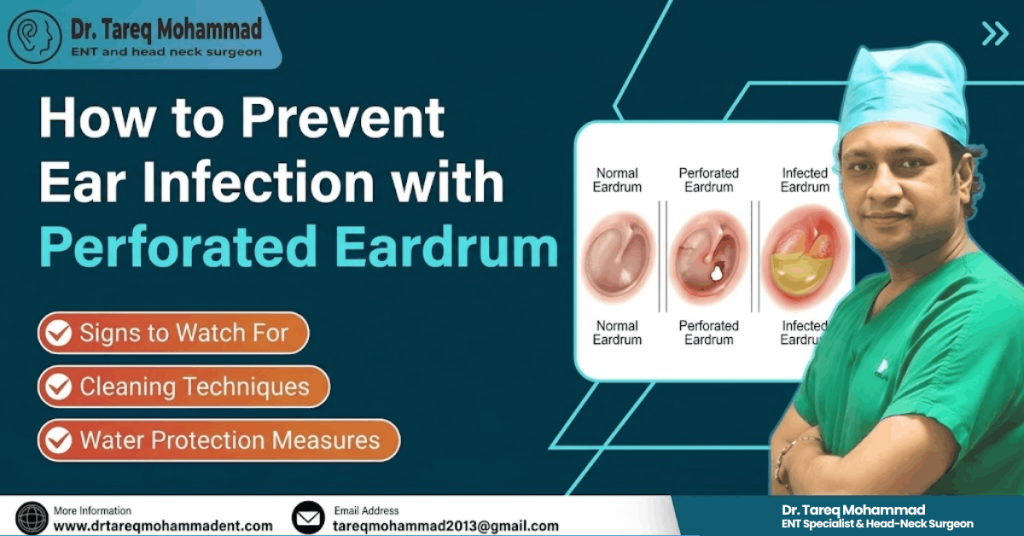
When a patient sits across from me in my clinic, holding their ear and looking visibly anxious, I often see the same underlying fear because a torn or ruptured eardrum feels incredibly unsettling. It changes how you hear, how you feel, and suddenly, everyday activities like taking a shower become a stressful logistical challenge. If you are dealing with a hole in your delicate hearing mechanism, your main priority right now must be defense, which is why learning how to prevent ear infection with perforated eardrum issues is the most vital step you can take today before bacteria can find a way inside.
To understand why your ear is suddenly so vulnerable, it helps to imagine your eardrum as a protective shield. In my practice, I often tell patients to view the tympanic membrane as a tightly stretched drum skin that seals off the delicate, sterile middle ear from the harsh outside world. It keeps out dirt, debris, and microscopic organisms.
When you experience a tympanic membrane perforation care becomes an absolute necessity because that protective barrier is gone.
A hole in this membrane creates an open doorway. The middle ear space is warm, dark, and moist—the exact kind of environment where bacteria love to multiply. Under normal circumstances, your ear can handle a little moisture or dust. But with a perforation, even a tiny drop of contaminated water slipping past the outer canal can trigger a severe, painful inflammatory response.
It is incredibly easy to confuse the baseline discomfort of a torn eardrum with the early stages of a true bacterial invasion. However, knowing the difference can save you from severe pain and potential hearing complications.
If bacteria manage to breach your middle ear, you will likely notice a rapid shift in your symptoms.
✦Changes in Discharge: Normal healing might involve a tiny bit of clear or slightly tinged fluid. A bacterial infection, however, usually causes thick, yellow, or foul-smelling fluid to drain from the canal.
✦Throb and Ache: A sudden escalation in deep, throbbing pain that keeps you awake at night is a classic indicator.
✦A Feeling of Fullness: An intense, heavy pressure inside the skull that does not improve when you swallow.
✦Fever and Chills: Systemic symptoms like a rising body temperature mean your immune system is actively fighting an infection.
✦Sudden Hearing Drop: A noticeable, rapid decline in your ability to hear conversations or distinct sounds.
In my daily practice here in Dhaka, I treat an incredibly wide variety of eardrum perforations, and many are heavily influenced by our local environment. The dense city traffic, seasonal monsoon changes, and dust levels play a massive role in ear health.
One of the most common causes I witness is the improper use of cotton buds. Many residents try to clear out environmental dust by aggressively cleaning their ears. This habit frequently leads to accidental punctures.
Additionally, chronic nasal allergies and sinus infections run rampant during our changing weather seasons. When your nose clogs up due to pollution or a sudden cold, fluid backs up behind the eardrum. If the pressure builds up too intensely, the membrane can pop from the inside out.
Finally, sudden pressure changes—such as a loud acoustic blast in heavy traffic or an accidental slap to the side of the head—can instantly tear the tissue.
If you were to walk into my clinic today with suspicions of a tear, the very first thing we would do is get a clear, highly detailed view of the damage. I do not rely on guesswork. We utilize advanced diagnostic tools to see exactly what we are dealing with.
First, I will use a high-definition video otoscope or perform a precise nasal endoscopy and ear scope check. This allows us to project a magnified, crystal-clear image of your ear canal onto a monitor.
During this assessment, I look at the exact size of the tear, its location on the membrane, and whether the edges are attempting to knit back together naturally. I also inspect the area for any hidden moisture, signs of early fungal growth, or pre-existing fluid collections. This detailed evaluation allows me to map out a highly customized protection plan tailored specifically to the unique shape of your ear canal.
Living with an open eardrum requires immediate, deliberate changes to your daily hygiene routine. You cannot afford to let standard environmental elements wander into your ear canal unchecked.
Water is your absolute worst enemy during the recovery phase. Dealing with water in ear with ruptured eardrum complications can set your healing progress back by weeks. When you bathe, you must create an airtight seal.
I highly recommend investing in high-quality, safe earplugs for showering with perforated eardrum protection. If you do not have specialized earplugs on hand, you can easily create a reliable barrier using a simple household method: take a clean cotton ball, coat the outside of it generously with petroleum jelly (Vaseline), and gently snuggle it into the bowl of your outer ear. The layer of grease will naturally repel stray water droplets.
I am frequently asked by fitness enthusiasts how to keep ears dry while swimming with a tear. My professional, non-negotiable advice is simple: stay out of the pool, river, or ocean entirely until I have confirmed the hole has fully closed.
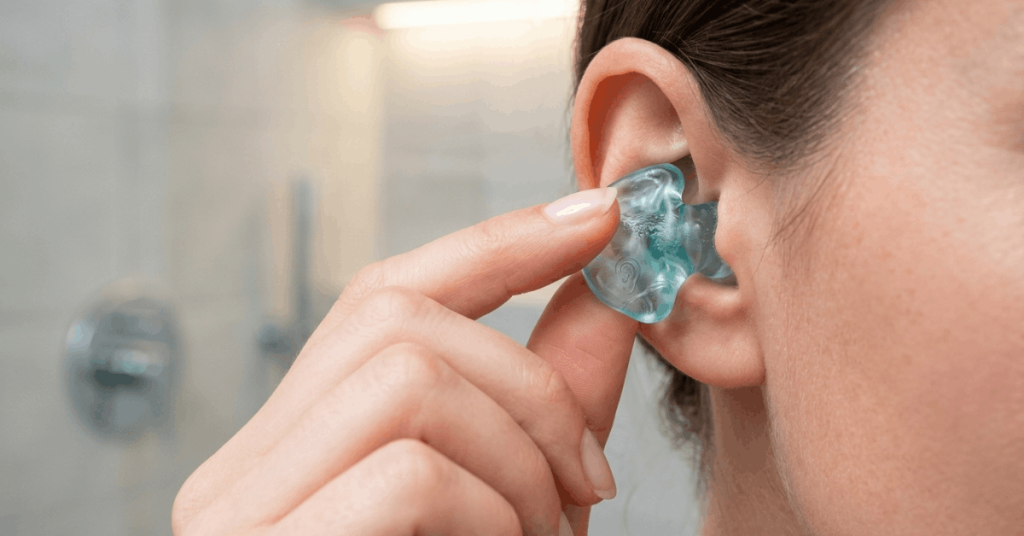
Even with specialized custom swim plugs and a tight neoprene head strap, the risk of microscopic water molecules carrying bacteria into your middle ear is simply too high. It is worth pausing your aquatic workouts for a brief period to protect your long-term hearing clarity.
Our bustling city streets can be incredibly dusty. When you are traveling through high-traffic zones or commuting on windy days, use a clean piece of cotton or custom ear protection for perforated eardrum defense to block airborne dust and pollutants from blowing directly down your ear canal.
Managing a perforation requires a dynamic strategy that shifts depending on how well your body is responding to natural recovery.
Treatment Phase | Management Strategy | Expected Outcomes / Interventions |
Initial Phase | Strict observation & water avoidance | Most small tears heal naturally within weeks. |
Infection Phase | Targeted prescription drops | Clears active bacterial growth safely. |
Surgical Phase | Tympanoplasty procedure | Permanently seals stubborn, chronic holes. |
It often surprises my patients to learn that the human body is remarkably efficient at repairing itself. The average eardrum perforation healing time ranges anywhere from a few weeks to three months for small, clean tears. During this observational phase, our primary goal is simply keeping the area dry and clean, giving the delicate skin cells the peace they need to bridge the gap.
If a mild infection does take hold, standard over-the-counter ear drops can actually be dangerous. Many common drops contain ingredients that are toxic to the inner ear if they slide through a hole.
Instead, I will prescribe specialized, non-ototoxic antibiotic ear drops for perforated eardrum care. These medications are carefully formulated to safely eradicate bacteria within the middle ear without causing any harm to your balance or hearing structures.
What happens if a hole refuses to close after several months? If a perforation remains stubbornly open or if a patient suffers from chronic, recurring infections, we transition to modern surgical options.
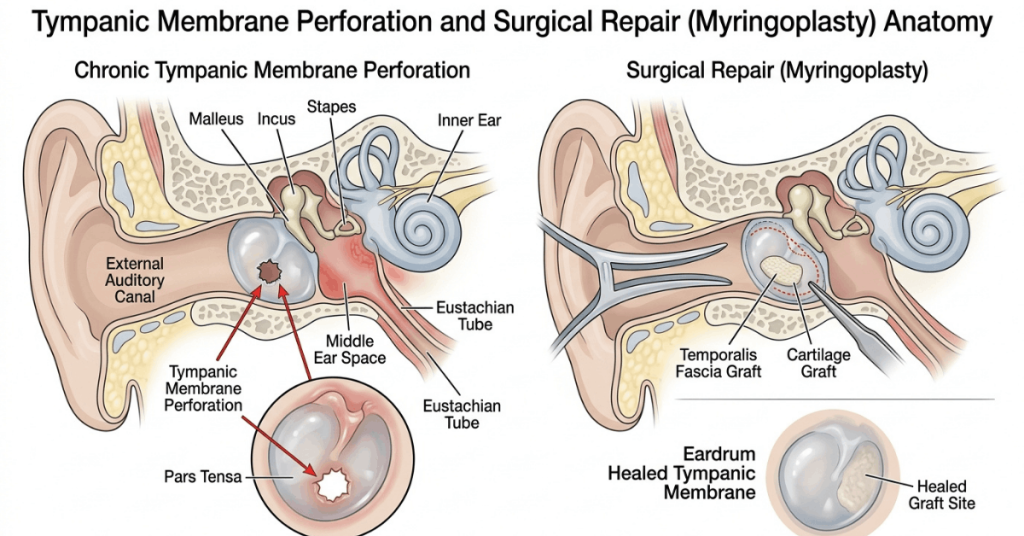
I routinely perform a highly effective, minimally invasive procedure known as a tympanoplasty. During this delicate microsurgery, I use a tiny piece of your own natural tissue—often taken from a small point just behind the ear—to patch the hole. This restores the protective barrier, shields you from future infections, and significantly improves your overall hearing quality.
Dealing with a perforated eardrum can feel restrictive and deeply frustrating, but it is important to remember that this is a highly treatable, manageable condition. By remaining vigilant about water protection, avoiding the temptation to use cotton swabs, and seeking professional ENT guidance at the first sign of trouble, you can easily guide your ear back to complete health. You do not have to navigate this recovery journey alone, and you absolutely do not have to live in constant fear of pain.
If you are currently experiencing ear pain, suspect you have a torn eardrum, or need a professional assessment to verify if your perforation has fully healed, please do not delay your care. My team and I are here to provide you with precise, compassionate clinical support.
📞 Call: +8801537240658
📧 Email: tareqmohammad2013@gmail.com
📍 Visit: Popular Medical College Hospital, Dhanmondi, House # 25, Road No. 2, Dhaka 1205
🌐 Book Online: Click Here to Schedule Your Appointment
Dr. Tareq Mohammad: Surprisingly, flying with a true perforation is often less painful than flying with a normal, intact eardrum. Because there is already a hole in the membrane, air pressure can equalize naturally between your external environment and your middle ear. However, the real danger is exposure to recirculated cabin air if you have an active head cold. Always consult me before booking a flight so we can ensure your nasal passages are completely clear.
Dr. Tareq Mohammad: You cannot reliably determine this based on how you feel alone. While an improvement in hearing or a decrease in wind-rushing sensations can suggest healing, the only definitive way to know is through a professional visual check. In my clinic, we take digital photographs of the membrane over consecutive visits to accurately track your healing progress.
Dr. Tareq Mohammad: First, do not panic, and absolutely do not insert a cotton bud or any sharp object to dry it out. Tilt your head sideways toward the affected shoulder and gently pull your outer ear lobe downward and backward to encourage the water to drain out naturally. You can also use a hairdryer set to its coolest, lowest setting, holding it a full arm’s length away from your face, to gently dry the canal with warm air movement. If deep pain or discharge develops over the next 48 hours, contact me immediately.

Dr. Tareq Mohammad, MBBS, FCPS (ENT – Head & Neck Surgery), Assistant Professor at Popular Medical College Hospital, providing advanced ENT care with compassion and expertise.
© Copyright 2026 Dr. Tareq Mohammad - All Rights Reserved.
Need help? Team is just a message away