
Child Snoring Adenoids – Causes, Signs & Treatment
Blog Single


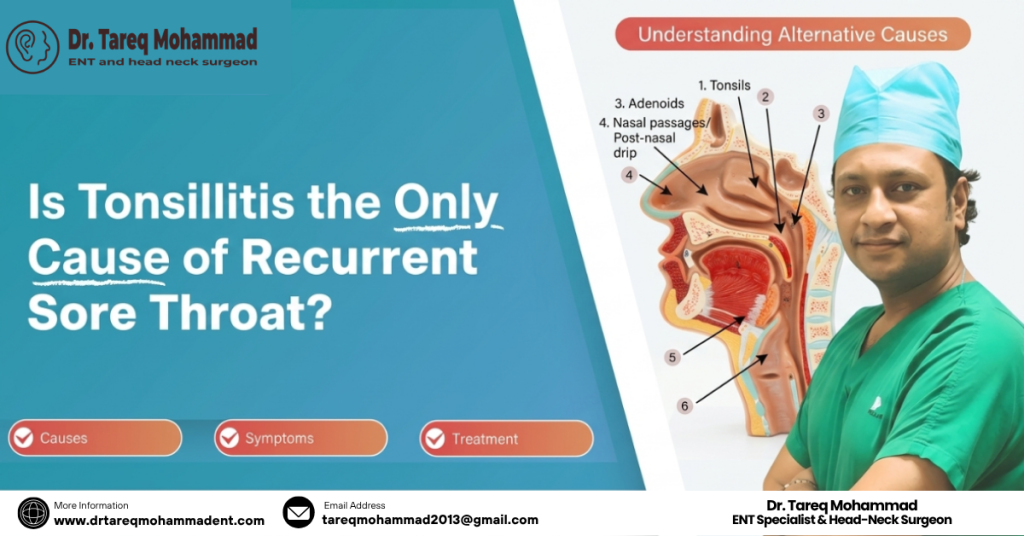
In my clinical practice as an ENT surgeon, I frequently meet patients who arrive exhausted by a constant, frustrating cycle of throat pain. Many tell me they have taken multiple courses of antibiotics, assuming their problem is a stubborn case of tonsillitis that simply refuses to go away. It is an incredibly common assumption. However, when a patient asks me if inflammation of the tonsils is the only true cause of recurrent sore throat, my answer is always a definitive no.
While a primary throat infection causes significant discomfort, numerous hidden culprits can mimic these symptoms. For many individuals, persistent throat pain persists even after their tonsils have been surgically removed. The purpose of this article is to explore the real, diverse factors behind this condition so you can find a lasting chronic sore throat treatment.
No, tonsillitis is not the sole cause of recurrent sore throat. While bacterial or viral infections frequently inflame the tonsils, chronic throat pain can also be triggered by non-infectious conditions. Common alternative culprits include acid reflux (LPR), environmental allergies, post-nasal drip, chronic sinusitis, mouth breathing, and even environmental irritants.
The most overlooked cause of recurrent sore throat in adults is Laryngopharyngeal Reflux (LPR), or “silent reflux,” where stomach contents irritate the delicate tissues of the upper throat. Other frequent non-tonsillitis causes include persistent post-nasal drip stemming from seasonal allergies or chronic sinusitis, prolonged mouth breathing due to a deviated septum, and continuous exposure to dry air or urban pollutants.
✦Multiple Culprits: Tonsillitis symptoms are highly visible, but silent reflux, sinus issues, and allergies cause identical, long-lasting throat rawiness.
✦Silent Reflux Impact: Laryngopharyngeal Reflux (LPR) can severely inflame your throat lining completely independent of classic chest heartburn.
✦Environmental Triggers: Urban factors like air quality, heavy dust, and seasonal allergens play a massive role in chronic throat irritation.
✦Accurate Diagnosis: Effective, long-term relief depends entirely on pinpointing the specific structural or medical cause via a professional evaluation.
When we talk about a recurrent sore throat, we are describing throat pain, scratchiness, or painful swallowing that either never fully resolves or disappears only to return every few weeks. In the medical field, we categorize these persistent issues based on how long they last and how frequently they cycle.
Unlike an isolated, acute bout of seasonal flu, a chronic or recurrent throat problem is not a disease in itself. Instead, it is a warning sign that something is continuously irritating the upper respiratory tract. This issue affects individuals across all age brackets. While children frequently experience classical viral or bacterial infections, adults are far more likely to suffer from chronic throat issues rooted in lifestyle factors, environmental exposures, or structural airway variations.
If you are struggling with ongoing throat discomfort, it is highly beneficial to look closely at your full spectrum of symptoms. In my practice, patients frequently experience a cluster of subtle signs that point directly away from standard tonsillitis symptoms and toward alternative underlying conditions:
✦A persistent “lump” or raw sensation in the back of the throat (globus pharyngeus).
✦An annoying, near-constant urge to clear your throat, especially right after waking up.
✦Throat burning or scratchiness that peaks in the early morning and gradually improves mid-day.
✦Intermittent hoarseness, minor voice changes, or early vocal fatigue when speaking.
✦Dryness, tickling, or a scraping sensation without any associated fever or body aches.
✦Enlarged tonsils or red, prominent tissue patches along the back wall of the pharynx, even without active pus or visible infection spots.
Based on my clinical experience as an ENT specialist for sore throat, identifying the precise trigger requires evaluating options beyond simple bacterial infections. Here are the four primary alternative conditions I diagnose most frequently:
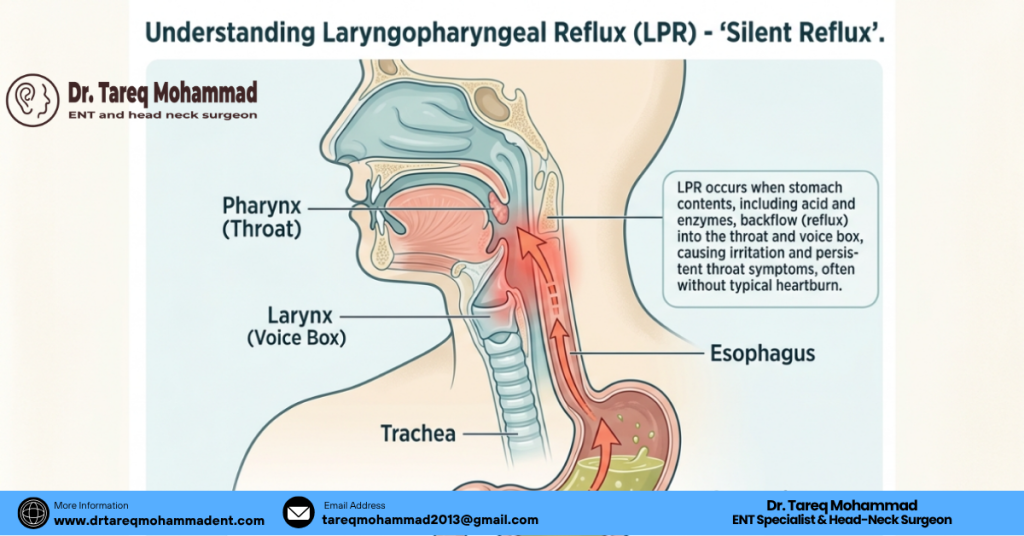
Often referred to as “silent reflux,” LPR is uniquely different from classic gastroesophageal reflux disease (GERD). Many patients are surprised when I suggest a digestive issue because they do not experience standard heartburn.
In LPR, stomach enzymes and microscopic droplets of acid travel all the way up the esophagus, spilling directly onto the highly sensitive linings of the voice box and lower throat. Because these upper tissues lack the protective coating found in the stomach, even trace amounts of acid cause profound, chronic tissue inflammation. This constant chemical irritation represents a leading structural cause of recurrent sore throat in adult patients.
Environmental triggers are incredibly prominent. When an individual suffers from environmental allergies, allergic rhinitis, or chronic sinus infections, the nasal passages produce an excessive volume of thick, inflammatory mucus.
Instead of exiting the nose normally, this fluid continuously flows down the back wall of the throat. This ongoing baseline dripping acts as a mechanical and chemical irritant, leaving the throat feeling incredibly raw, tender, and uniquely susceptible to secondary superficial discomfort.
Optimal throat health relies heavily on a moist, well-lubricated mucosal lining. If a patient suffers from a structural nasal obstruction—such as a severely deviated nasal septum, nasal polyps, or enlarged turbinates—they are naturally forced to breathe primarily through their mouth, particularly while sleeping.
Breathing ambient air continuously through the mouth bypasses the natural humidifying and filtering systems of the nasal passages. This directly dries out the delicate pharyngeal tissues, producing a raw, uncomfortable morning sore throat that cycles day after day.
It is entirely possible to experience a genuine recurrent throat infection without the tonsils being actively involved. The wide tissue spaces surrounding the tonsils, known as the pharyngeal walls, can harbor recurrent viral strains or low-grade bacterial colonization. Additionally, if an initial round of treatment for an acute infection was cut short, the underlying bacteria can quietly rebound the moment the immune system experiences minor stress.
I often advise my patients that a simple visual inspection using a standard wooden tongue depressor is rarely enough to uncover a chronic cause of recurrent sore throat. To provide an accurate path forward, a comprehensive, specialized ENT evaluation is necessary.
During an evaluation in our clinic, we utilize a specialized procedure called a Nasal Endoscopy. This involves passing a microscopic, highly flexible fiber-optic camera through the nasal pathways. This diagnostic tool allows me to view the entire nasal cavity, the back of the nasopharynx, the base of the tongue, and the moving structures of the larynx in real time.
By analyzing the specific patterns of redness, swelling, or localized mucus accumulation, I can reliably confirm or rule out conditions like hidden sinus disease, structural blockages, or the distinct tissue changes caused by silent reflux. When indicated, we also coordinate detailed allergy testing or diagnostic imaging to build a highly tailored management strategy.
Achieving a successful chronic sore throat treatment requires mapping targeted solutions directly to the verified medical diagnosis:
When an allergy or chronic sinus inflammation is confirmed, targeted medical therapy is highly effective. This approach frequently includes utilizing modern, non-drowsy antihistamines, prescription corticosteroid nasal sprays to reduce tissue swelling, or specialized saline rinses to flush out trapped allergens.
If our diagnostic findings point directly to Laryngopharyngeal Reflux (LPR), I frequently prescribe a structured course of acid-suppressing medications, such as proton pump inhibitors (PPIs) or H2 blockers, which allow the irritated upper respiratory linings to completely heal over time.
I have treated many patients who achieved remarkable, long-lasting relief by introducing strategic updates to their daily habits. If silent reflux is a factor, I strongly advise avoiding heavy, rich, or highly spiced meals for at least three to four hours before lying down to sleep.
Modifying your sleeping posture by elevating the head of your bed by six inches can naturally utilize gravity to keep stomach acids where they belong. Furthermore, identifying and minimizing personal exposure to common irritants—such as avoiding active tobacco smoke, utilizing indoor air purifiers, and avoiding highly toxic industrial cleaners—can dramatically reduce baseline throat inflammation.
For supportive, daily comfort, simple home practices offer excellent symptomatic support. Consistent hydration throughout the day thins out thick post-nasal mucus and protects raw tissues.
Regularly performing warm saltwater gargles remains a time-tested, evidence-based approach to naturally drawing out tissue fluid accumulation and soothing local nerve irritation. Additionally, utilizing a clean, cool-mist humidifier in your bedroom can add critical moisture back into dry ambient air, providing vital protection against morning throat dryness.
Surgical intervention is strictly reserved for scenarios where clear structural deviations or irreversible tissue modifications are confirmed. For instance, if a patient presents with chronic, deeply embedded tonsillar abscesses or meets strict clinical criteria for recurrent bacterial tonsillitis, a tonsillectomy is highly effective.
Similarly, if a structural abnormality like a deviated nasal septum is forcing chronic mouth breathing, performing a precise corrective septoplasty can permanently restore clear nasal breathing and eliminate chronic throat drying.
While minor, occasional throat irritation can often be managed comfortably at home, specific red-flag indicators necessitate a prompt evaluation by an expert ENT specialist for sore throat. I strongly encourage scheduling a professional assessment if your throat discomfort extends beyond a continuous two-week window despite trying standard home remedies.
Furthermore, if your throat pain is accompanied by difficulty swallowing solid foods, unexpected breathing changes, persistent one-sided neck pain, an unexplained lump in the neck, or continuous hoarseness lasting more than ten days, seeking professional care is essential. Delaying an accurate diagnosis can allow an easily treatable structural issue or low-grade irritation to develop into a much more complex, long-term health challenge.
Primary Symptoms | Accompanying Signs | Most Likely Underlying Cause |
Severe swallowing pain, acute high fever | Visible white pus spots on tonsils, swollen neck nodes | Acute Bacterial Tonsillitis |
Constant throat tickle, morning rawness | Persistent clear mucus drip, frequent sneezing, itchy eyes | Allergic Post-Nasal Drip |
Morning throat burning, dry cough | Sensation of a lump in the throat, intermittent vocal hoarseness | Laryngopharyngeal Reflux (LPR) |
Intense throat dryness specifically upon waking | Frequent nasal congestion, history of snoring or dry mouth | Structural Mouth Breathing |
Treatment Category | Specific Approach | Expected Clinical Benefit |
Medical Management | Proton Pump Inhibitors (PPIs) | Lowers stomach acid production, allowing upper throat tissue to heal. |
Allergy Control | Intranasal Corticosteroid Sprays | Directly reduces sinus tissue swelling, eliminating post-nasal drip. |
Surgical Correction | Septoplasty / Turbinate Reduction | Removes structural blockages, restoring healthy night-time nasal breathing. |
Targeted Surgery | Adult Tonsillectomy | Permanently removes chronically infected lymph tissue to stop tonsillitis cycles. |
Assistant Professor, Department of ENT & Head-Neck Surgeon
Dr. Tareq Mohammad is a dedicated healthcare specialist based in Dhaka, Bangladesh. Serving as an Assistant Professor, he combines advanced clinical insights with modern diagnostic tools to treat complex disorders of the ear, nose, and throat. He is committed to providing evidence-based, compassionate care tailored to each patient’s lifestyle.
Official Website: Dr. Tareq Mohammad
Contact & Booking: Click Here to Schedule Your Appointment
Professional WhatsApp: +8801537240658
If you are tired of managing a painful throat cycle with temporary fixes, it is time to find definitive answers. Discovering the true cause of your symptoms is the first step toward long-term comfort.
📞 Direct Hotline: +8801537240658
📧 Official Email Contact: tareqmohammad2013@gmail.com
📍 Clinical Location: Popular Medical College Hospital, House #25, Road #2, Dhanmondi, Dhaka 1205, Bangladesh
🌐 Online Appointment Scheduling: Click Here to Schedule Your Appointment
Question: Can chronic stress or anxiety cause a recurrent sore throat?
Answer: Yes, chronic stress can contribute indirectly. Prolonged emotional anxiety triggers elevated production of gastric acid, significantly increasing your risk for Laryngopharyngeal Reflux (LPR). Additionally, stress can cause subconscious tension in the muscles surrounding the larynx, resulting in a persistent globus sensation, throat tightness, or an aching feeling that mirrors a sore throat.
Question: Why does my throat feel sore every morning but improves after breakfast?
Answer: This pattern strongly indicates either nocturnal mouth breathing or silent acid reflux. While sleeping horizontally, stomach acid can easily travel upwards into the throat, or open-mouth breathing can severely dehydrate the throat tissues. Once you wake up, stand upright, and begin drinking fluids, saliva naturally washes away the acid and rehydrates the tissue, easing the discomfort.
Question: Is it safe to take antibiotics every time my sore throat returns?
Answer: Absolutely not. Antibiotics are designed exclusively to eliminate bacterial infections, such as Strep throat. Taking them repeatedly for viral infections, acid reflux irritation, or environmental allergies is ineffective and carries risks. It can disrupt your natural gut microbiome and contribute to global antibiotic resistance. A targeted diagnosis should always come before medication.
Question: How does air pollution in major urban areas like Dhaka impact my throat?
Answer: High concentrations of dust, vehicle emissions, and seasonal particulate matter directly irritate the delicate upper respiratory tract. This continuous environmental exposure can trigger non-allergic chronic pharyngitis or exacerbate underlying allergic rhinitis. The resulting inflammation and post-nasal drip can easily create a persistent, cycling sore throat.
Question: Can my tonsils still be the cause if they look normal during a quick look?
Answer: Yes. Deep within the complex folds and tissue crevices (crypts) of the tonsils, low-grade bacterial colonies can sometimes persist without causing massive swelling or obvious surface pus. Additionally, tissue at the very base of the tongue, known as the lingual tonsils, can become chronically inflamed and require a specialized endoscopic evaluation to visualize clearly.

Dr. Tareq Mohammad, MBBS, FCPS (ENT – Head & Neck Surgery), Assistant Professor at Popular Medical College Hospital, providing advanced ENT care with compassion and expertise.
© Copyright 2026 Dr. Tareq Mohammad - All Rights Reserved.
Need help? Team is just a message away