At what extent headache is related with nasal obstruction?
Blog Single


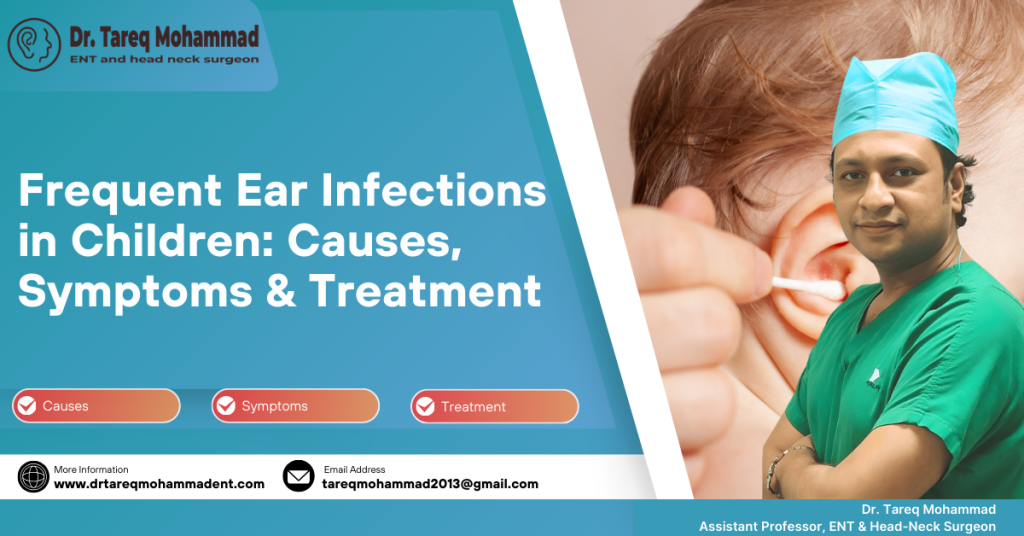
As an ENT specialist, one of the most common concerns I hear from parents is: “My child keeps getting ear infections — is this normal?” I completely understand your worry. Frequent ear infections can be painful for your little one and stressful for your whole family. The good news is that with the right diagnosis and care, we can manage recurrent ear infections effectively and protect your child’s long-term hearing health.
Children often cannot clearly describe ear pain, so knowing the warning signs is essential for every parent. Here are the most common symptoms I look for in clinic:
✦Ear pain, or tugging and pulling at the ear
✦Difficulty hearing, or not responding to sounds normally
✦Fever, especially in younger children under 2
✦Fluid or discharge draining from the ear canal
✦Irritability, persistent crying, or disturbed sleep
✦Balance problems or unusual clumsiness
✦Delayed speech or language development in toddlers
If your child experiences three or more ear infections within six months, or four within a year, I classify this as recurrent otitis media — and it deserves a thorough ENT evaluation without delay.
Parents often ask me, “Why does my child keep getting ear infections?” The answer usually lies in a combination of anatomy, immunity, and environment. In young children, the Eustachian tube — the passage connecting the middle ear to the back of the throat — is shorter and more horizontal than in adults. This makes it easier for bacteria and viruses to travel into the middle ear.
The most common causes and risk factors I see include:
✦Immature immune system — children under 5 are most vulnerable
✦Daycare or school attendance — close contact spreads germs rapidly
✦Bottle-feeding while lying down -increases fluid pooling near the Eustachian tube
✦Secondhand smoke exposure — irritates the middle ear lining and impairs drainage
✦Allergies or enlarged adenoids — these block normal Eustachian tube function
✦Family history — genetics can influence a child’s susceptibility
Previous ear infections — scarring can reduce natural drainage over time
When a parent brings their child to me, I always personalise the treatment plan based on the child’s age, frequency of infections, and overall health. Here is how I approach care:
✦Antibiotics: For confirmed bacterial infections, I prescribe a carefully selected course of antibiotics to avoid the risk of antibiotic resistance.
✦Pain relief: Age-appropriate medicines such as paracetamol or ibuprofen help manage ear pain and fever effectively.
✦Watchful waiting: For mild cases in children over 2, I may monitor for 48–72 hours before prescribing medication, as many infections resolve naturally.
✦Apply a warm (not hot) cloth gently against the ear to soothe pain
✦Keep your child upright during feeding to reduce fluid backflow
✦Ensure adequate rest and fluid intake during recovery
✦Avoid exposing your child to cigarette smoke at all times
If your child has had four or more infections within a year, or has persistent glue ear causing hearing loss, I may recommend a minor procedure called myringotomy with grommet insertion. Tiny ventilation tubes are placed in the eardrum to allow fluid to drain and relieve pressure. It is a quick, safe, and highly effective procedure performed under a brief general anaesthetic. Most children go home the same day and notice a significant improvement in hearing almost immediately.
When to See an ENT Specialist
I always encourage parents to trust their instincts. Please seek specialist care promptly if you notice any of the following:
✦Three or more ear infections within six months
✦Noticeable hearing loss or speech delay in your child
✦Ear discharge lasting more than 24 hours
✦High fever not improving with standard treatment
✦Swelling, redness, or tenderness behind the ear (possible mastoiditis)
✦Repeated antibiotic courses with no lasting improvement
Early intervention is always better than waiting. The sooner I assess your child, the sooner we can prevent complications such as permanent hearing damage or speech and learning delays.
While not every ear infection can be prevented, I recommend these simple, evidence-based steps:
✦Breastfeed if possible — breast milk provides immune-boosting antibodies
✦Keep vaccinations current — especially the pneumococcal (PCV) and annual flu vaccines
✦Eliminate secondhand smoke — even passive exposure significantly raises risk
✦Teach regular handwashing — reduces transmission of bacteria and viruses
✦Feed your baby upright — hold at a 45° angle during bottle feeding
✦Manage allergies early — controlling nasal inflammation reduces Eustachian tube swelling
Frequent ear infections in children are among the most treatable conditions I manage in my ENT practice — and you should never feel alone in navigating them. Whether your child needs medical treatment, simple home care, or a straightforward procedure like grommet insertion, the key is early and accurate diagnosis. I am committed to giving every child the personalised, compassionate care they deserve, so they can hear clearly, communicate confidently, and grow up healthy.
If your child has been experiencing repeated ear infections, please do not hesitate to reach out. Together, we will find the right path forward for your family.
Don’t wait for ear infections to become a recurring problem. I am here to help your child hear, heal, and thrive.
📞 Call / WhatsApp: +8801537240658
📧 Email: tareqmohammad2013@gmail.com
📍 Clinic: Popular Medical College Hospital, Dhanmondi
🌐 Website: https://drtareqmohammadent.com/
Q1:How many ear infections are considered “frequent” in children?
I consider ear infections to be recurrent when a child has three or more episodes within six months, or four or more within a single year. At that point, I recommend a full ENT evaluation to identify the underlying cause and plan the most effective long-term management.
Q2: Can frequent ear infections cause permanent hearing loss?
Yes, if left untreated they can. Repeated infections may lead to glue ear, where thick fluid behind the eardrum reduces hearing. Early treatment and monitoring are key to preventing any lasting damage to your child’s hearing.
Q3: Are ear tubes (grommets) safe for young children?
Absolutely. Grommet insertion is one of the most commonly performed procedures in paediatric ENT, and I have seen it significantly improve quality of life for many young patients. The procedure is brief, low-risk, and most children recover and go home the same day.
Q4: What is the difference between otitis media and glue ear?
Otitis media is an active infection causing pain, fever, and irritability. Glue ear (otitis media with effusion) is a build-up of thick fluid behind the eardrum without active infection — often painless but causing noticeable hearing difficulty. I assess for both during every consultation.

Dr. Tareq Mohammad, MBBS, FCPS (ENT – Head & Neck Surgery), Assistant Professor at Popular Medical College Hospital, providing advanced ENT care with compassion and expertise.
© Copyright 2026 Dr. Tareq Mohammad - All Rights Reserved.
Need help? Team is just a message away