Child Snoring Adenoids – Causes, Signs & Treatment
Blog Single


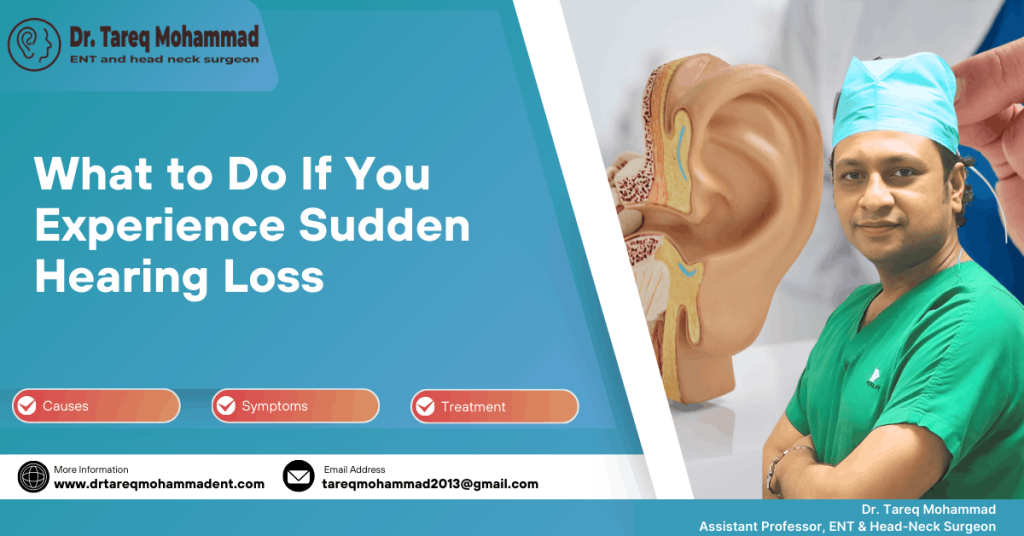
One moment you can hear normally — the next, the sound in one ear has dropped dramatically or disappeared entirely. If this has happened to you, I need you to read this carefully: sudden hearing loss is a medical emergency, and the time between when it happens and when you receive treatment can determine whether your hearing returns. I have treated many patients who waited days before seeking help — and I do not want that to happen to you.
Sudden hearing loss — medically known as sudden sensorineural hearing loss (SSHL) — typically affects one ear and develops within hours or over a few days. Here is what I ask my patients to look out for:
✦A rapid, noticeable drop in hearing in one ear, sometimes noticed upon waking
✦A sensation of the ear feeling blocked or full, without any visible cause
✦Tinnitus — a ringing, buzzing, or hissing sound that appears alongside the hearing drop
✦Vertigo or dizziness occurring at the same time as the hearing change
✦Difficulty understanding speech, particularly on phone calls or in quiet rooms
✦Sounds appearing distorted or muffled on the affected side
Even if your hearing loss feels mild or you think it might resolve on its own — please do not wait. In my clinical experience, the window for effective treatment is narrow. The earlier I see you, the better your outcome
In approximately half of all cases, I cannot find a single identifiable cause —
this is termed idiopathic SSHL. However, there are several known triggers
I always examine
✦Viral infections — viruses such as herpes simplex, mumps, or influenza can damage the cochlear nerve or inner ear hair cells
✦Vascular disruption — reduced blood flow to the inner ear, often linked to cardiovascular risk factors
✦It is a disorder in which the immune system unintentionally harms the inner ear.
✦Acoustic trauma — a single exposure to an extremely loud noise (explosion, concert, industrial equipment)
✦Acoustic neuroma — a benign tumour on the hearing nerve that can cause progressive or sudden one-sided hearing loss
✦Ototoxic medications — certain antibiotics, chemotherapy drugs, and anti-inflammatories can damage inner ear structures
✦Meniere’s disease — inner ear fluid imbalance causing episodic hearing loss, vertigo, and tinnitus
This is where timing is everything. I always tell my patients: treat sudden
hearing loss like a stroke — act fast. Here is how I approach it:
✦High-dose oral corticosteroids — this is my primary treatment for SSHL, prescribed immediately to reduce inner ear inflammation. Studies show the best outcomes when steroids are started within 72 hours of onset.
✦Intratympanic steroid injections — if oral steroids are insufficient or contraindicated,
I inject steroid medication directly through the eardrum into the middle ear for targeted delivery
✦Antiviral medication — prescribed alongside steroids when a viral cause is suspected
✦Hyperbaric oxygen therapy (HBOT) — I may refer selected patients for this adjunct therapy, which increases oxygen delivery to the damaged inner ear tissue
✦Rest adequately and avoid stress, which can worsen inner ear inflammation
✦Avoid loud noise exposure during the recovery period
✦Do not use cotton buds or introduce anything into the ear canal
✦Attend all follow-up audiogram appointments so I can monitor your recovery closely
If hearing does not recover fully — which I assess after a course of treatment —
I will discuss hearing aids or, in selected cases, a cochlear implant referral to restore hearing function as effectively as possible.
I want to be completely direct with you here: sudden hearing loss requires same-day or next-day ENT assessment. If you notice any of the following, go for emergency medical care immediately:
✦Any sudden unexplained drop in hearing in one or both ears
✦Hearing loss upon waking that was not present the night before
✦Tinnitus appearing suddenly alongside reduced hearing
✦Dizziness or balance problems accompanying the hearing change
✦Hearing loss following a very loud noise exposure
✦One-sided hearing loss with no obvious cause such as wax or infection
Take early action rather than waiting for changes: Every hour without treatment narrows the recovery window.
While sudden hearing loss is not always preventable, I advise my patients to:
✦Wear ear protection at concerts, construction sites, or around loud machinery
✦Manage cardiovascular risk factors — high blood pressure and poor circulation affect inner ear blood supply
✦Inform your doctor of all medications you take, so ototoxic drugs can be monitored
✦Treat viral infections promptly and rest fully during recovery
✦Schedule regular hearing checks if you are over 50 or work in a noisy environment
Sudden hearing loss cannot wait until a regular appointment.
Contact my clinic today for a priority evaluation.
📞 Call / WhatsApp: +8801537240658
📧 Email: tareqmohammad2013@gmail.com
📍 Clinic: Popular Medical College Hospital, Dhanmondi, Dhaka 1205
Book an Appointment today with a certified ENT specialist to discuss your ear health and treatment options.
Sudden hearing loss is one of the few ENT emergencies where the speed of treatment directly determines the outcome. If you or a loved one suddenly experiences a change in their hearing, please do not wait, do not self-medicate, and do not assume that it will go away on its own. I have successfully helped many patients regain significant portions of their hearing when they came to me quickly and received the right treatment without delay. My commitment is to act quickly, perform a thorough examination, and give your hearing every possible chance to recover.
Let me help you protect it.
Q1: Can sudden hearing loss come back on its own without treatment?
Sometimes, in very mild cases, the disease will get better on its own —
but I don’t recommend relying on it. In my experience, patients who start steroid treatment quickly have significantly higher recovery rates than those who wait. Partial recovery is much better than permanent damage, and the sooner treatment is started, the better your chance of recovery.
Q2: Is sudden hearing loss always permanent?
Not necessarily — and this is exactly why urgent treatment matters. With early high-dose steroid therapy, many patients recover partial or full hearing.
The prognosis depends on the severity of the initial loss, how quickly treatment begins, and the underlying cause. I always conduct a thorough audiological assessment to guide the most targeted treatment plan.
Q3: What is the difference between sudden hearing loss and a blocked ear?
A blocked ear from wax, fluid, or congestion causes conductive hearing loss — sound is physically obstructed. Sudden sensorineural hearing loss involves damage to the inner ear nerve or hair cells — the sound reaches the ear, but the signal does not transmit properly. I can distinguish between these with a simple clinical examination and tuning fork test, followed by a formal audiogram.
Q4: If I suddenly lose my hearing, should I go to the emergency department or an ENT specialist?
As a first step, I recommend contacting an ENT specialist directly, as we are best placed to diagnose and treat this condition quickly. If you are unable to get to an ENT clinic on the same day, it is best to go to the emergency department — especially if the sudden hearing loss is accompanied by severe dizziness, facial weakness, or any neurological symptoms that require urgent medical attention.

Dr. Tareq Mohammad, MBBS, FCPS (ENT – Head & Neck Surgery), Assistant Professor at Popular Medical College Hospital, providing advanced ENT care with compassion and expertise.
© Copyright 2026 Dr. Tareq Mohammad - All Rights Reserved.
Need help? Team is just a message away