
Child Snoring Adenoids – Causes, Signs & Treatment
Blog Single


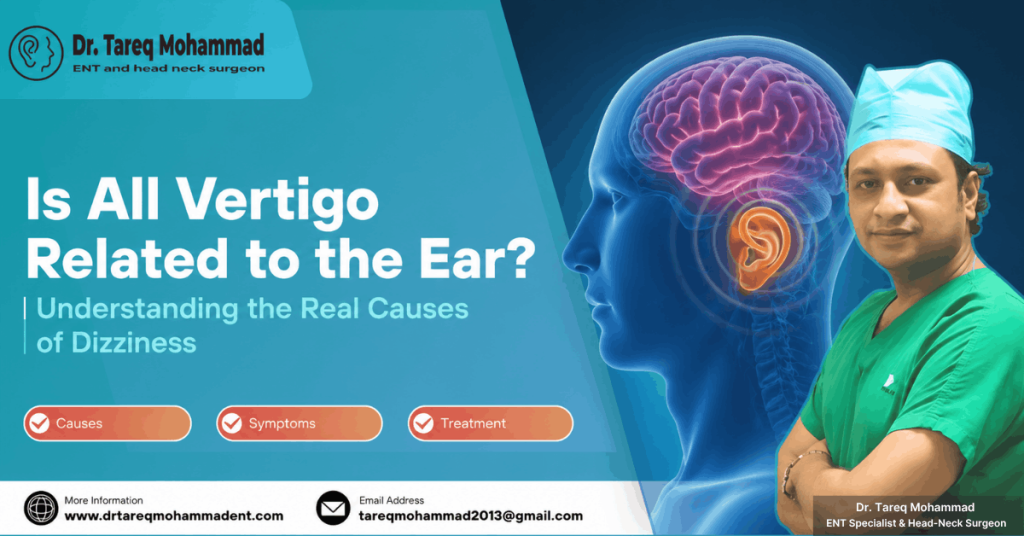
Every week, at least a handful of patients walk into my clinic in Dhaka saying the same thing — “Doctor, I keep feeling like the room is spinning around me.” Some have been dealing with it for days. Others, for months. And almost all of them come in assuming it must be an ear problem. Sometimes they are right. But understanding the full range of vertigo causes is what separates a quick fix from a real, lasting solution — and that is exactly what I want to help you with today.
This distinction trips people up constantly, so I always address it first.
Vertigo is a false sense of movement. You feel like you — or the room around you — is spinning, tilting, or rotating, when nothing is actually moving. It can be gentle, barely noticeable. Or it can hit so suddenly and violently that you have to grab a wall just to stay upright.
General dizziness is different — it is more of a lightheaded, foggy, “I might faint” sensation. Important, yes. But not the same as vertigo.
Why does the distinction matter? Because true vertigo almost always points to a disturbance in the body’s balance system — which can live in the ear, the brain, or occasionally the structures in between. Knowing which one is step one of any proper evaluation.
Inside your inner ear — tucked away behind your eardrum in a space barely the size of a pea — sits a remarkable structure called the vestibular system. Three fluid-filled semicircular canals and two small sensory organs work together to track every tilt, rotation, and movement of your head. Every second. Without you thinking about it.
When something disturbs that system — a displaced crystal, swelling, fluid pressure, or nerve inflammation — your brain receives conflicting signals. Your eyes say “we are still.” Your inner ear says “we are spinning.” That mismatch is vertigo.
✦BPPV — Benign Paroxysmal Positional Vertigo. The most common of all. Tiny calcium carbonate crystals called otoliths break loose from their normal position and drift into the fluid-filled canals where they do not belong. The result is a brief but intense spinning episode triggered by a specific movement — rolling over in bed, bending down, looking up at a shelf. Patients often describe it vividly: “Doctor, I turned over at night and the whole room spun for about thirty seconds. I thought I was dying.” The good news — BPPV is highly treatable, often in a single clinic visit.
When something disturbs that system — a displaced crystal, swelling, fluid pressure, or nerve inflammation — your brain receives conflicting signals. Your eyes say “we are still.” Your inner ear says “we are spinning.” That mismatch is vertigo.
✦Vestibular Neuritis. A viral infection inflames the nerve that carries balance signals from the inner ear to the brain. The vertigo here can be severe and prolonged — lasting days — and tends to follow a cold or flu by a week or two.
✦Labyrinthitis. Similar to vestibular neuritis, but the inflammation also involves the hearing organ itself. So alongside vertigo, the patient often notices hearing loss or ringing in the ear.
✦Meniere’s Disease.A disorder in which extra fluid accumulates within the inner ear, leading to repeated episodes of vertigo that can continue from around 20 minutes to several hours. . Almost always accompanied by muffled hearing, a feeling of fullness in the ear, and tinnitus.
“In my clinical experience, BPPV is responsible for nearly 25% of the vertigo patients I assess — and many of them experience significant relief soon after treatment. a simple repositioning manoeuvre.”
This is where things get genuinely interesting — and where misdiagnosis happens most often.
A substantial number of patients who come to me with vertigo have a cause that has nothing to do with their ear at all. I have seen patients who had been on vertigo medication for three to four months without relief — because nobody had explored whether the problem might be originating elsewhere.
🧠 Central Vertigo
Originates in the brain — stroke, TIA, multiple sclerosis, or tumour. Often accompanied by other neurological signs.
🦴Cervical Vertigo
Upper neck problems — arthritis, whiplash — can compress blood flow or send wrong signals to the balance centres.
💆Migraine-Associated
Vestibular migraine causes vertigo episodes — sometimes without any headache at all.
❤️Cardiovascular
Low blood pressure, arrhythmia, or anaemia can briefly reduce blood flow to the brain, causing dizziness or spinning.
💊Medication Side Effects
Certain antibiotics, blood pressure drugs, and sedatives are known to disturb balance and cause dizziness.
🧘Anxiety & Panic
Chronic anxiety can genuinely produce a persistent sense of dizziness and unreality — not imagined, but real physiology.
Of all of these, central vertigo is the one that must never be missed. A stroke or TIA can present with vertigo as its main — or even only — symptom, particularly in older patients or those with cardiovascular risk factors. This is why I never evaluate a vertigo patient in isolation. I look at the whole picture.
No test alone will give you the answer. Vertigo diagnosis is a clinical skill — it requires listening carefully, examining thoroughly, and thinking across specialties.
When you come to see me for vertigo, here is roughly what happens:
The goal of all this is not to run tests for the sake of it — it is to arrive at a precise diagnosis as efficiently as possible, so we can start the right treatment without delay.
The treatment for vertigo is not one thing. It is completely different depending on the cause. This is the point I keep coming back to, because it is so clinically important.
For ear-related vertigo:
✦BPPV → The Epley manoeuvre. A specific sequence of head movements performed in my clinic that repositions the displaced crystals. Most patients feel significant or complete relief within one to three sessions. It is one of the most satisfying treatments I perform — the change is often immediate and dramatic.
✦Vestibular neuritis / labyrinthitis → Anti-inflammatory medications (steroids), antivirals if indicated, and vestibular rehabilitation exercises to help the brain recalibrate.
✦Meniere’s disease → A low-salt diet, diuretics, corticosteroid injections into the middle ear in resistant cases, and surgery for severe, medication-resistant cases. Long-term management, but absolutely manageable.
For non-ear vertigo:
✦Cervical vertigo → Physiotherapy focused on the upper cervical spine, posture correction, sometimes guided exercises.
✦Vestibular migraine → Migraine preventive medications, dietary adjustments, sleep hygiene, and stress reduction.
✦Cardiovascular causes → Managed in collaboration with a cardiologist — blood pressure optimisation, arrhythmia treatment.
✦Anxiety-related dizziness → Cognitive behavioural therapy, breathing techniques, and occasionally short-term anxiolytics. Dismissing this as “just anxiety” is a mistake — the brain-body connection is real and the treatment is real.
Come and see me specifically if:
✦Your spinning episodes are triggered by lying down, rolling over in bed, or looking upward — this pattern is very characteristic of BPPV.
✦You also have ringing in the ear, muffled hearing, or a sensation of pressure or fullness inside the ear.
✦You recently had a cold, flu, or viral illness — and the dizziness started a week or two later.
✦Your dizziness is recurring in distinct episodes lasting 20 minutes to several hours, and you are losing hearing between attacks.
✦You have been given “vertigo tablets” without any proper investigation and they are simply not working.
✦Sudden, severe headache — especially described as “the worst headache of my life”
✦Difficulty speaking, swallowing, or understanding speech
✦Sudden weakness or numbness in the face, arm, or leg
✦Vision problems — blurring, double vision, or loss of vision
✦Difficulty walking or a sudden inability to coordinate movement
Not all forms of vertigo are preventable — BPPV, for example, can happen to anyone, often without a clear trigger. But there are things you can do to reduce your risk or minimise the frequency of attacks:
✦Stay well hydrated. Dehydration affects blood pressure and inner ear fluid balance — both of which feed into dizziness.
✦Sleep with your head slightly elevated if you have recurrent BPPV — it may help reduce crystal displacement.
✦Cut down on salt if you have been diagnosed with Ménière’s disease. The relationship between sodium intake and inner ear fluid pressure is well established.
✦Manage your stress actively — chronic anxiety is a genuine contributor to vestibular symptoms in many of my patients.
✦Review your medications with your doctor if you have recently started a new drug and developed dizziness — ototoxic drugs are a real and underappreciated cause.
✦Do not ignore a “minor” vertigo episode. One episode that resolves is worth mentioning at your next doctor visit. Recurring episodes need proper investigation.
Vertigo is not a diagnosis — it is a symptom. And like most symptoms, it has many possible causes, each with its own specific treatment. The ear is the starting point for many cases, yes. But assuming every spinning sensation is an “ear problem” and treating it accordingly is a shortcut that can cost patients months of unnecessary suffering.
What I find most rewarding in my work is this: patients who have been dizzy for months — sometimes years — and assumed they simply had to live with it. Proper evaluation, a precise diagnosis, and the right treatment plan, and they walk out feeling like themselves again. That outcome is always possible. But it begins with asking the right questions.
If you are in Dhaka and you have been dealing with recurring vertigo or unexplained dizziness, please do not keep managing it alone with over-the-counter medication. Come and see me. Let us find out exactly what is going on — and then fix it.
Still Spinning? Let’s Find the Real Answer Together.
Whether your vertigo started yesterday or has been bothering you for years, a proper evaluation can change everything. Reach out to my clinic — and let’s get you the clarity you deserve.
📞→Call +880 1537-240658
📧→ Email tareqmohammad2013@gmail.com
📍 Visit→Popular Medical College Hospital, Dhanmondi, House #25, Road No. 2, Dhaka 1205
You do not have to keep living with dizziness. Early diagnosis means faster recovery.
Q1: I had one vertigo episode that lasted about 30 seconds when I turned over in bed. Should I be worried?
Not necessarily worried — but definitely pay attention. A brief spinning episode triggered by a specific head movement is the classic presentation of BPPV, the most treatable form of vertigo. In my clinic, I can usually confirm this with a simple bedside test and treat it the same day using the Epley manoeuvre. One episode may not recur. But if it happens again, come and see me rather than waiting to see how bad it gets.
Q2: My vertigo happens without any ear symptoms at all — no ringing, no hearing loss. Does that mean my ear is fine?
Not necessarily. Some ear-related conditions — including BPPV and vestibular neuritis — cause vertigo without any obvious hearing change. Equally, some non-ear causes like vestibular migraine or cervical vertigo also present without ear symptoms. The absence of ear symptoms narrows things, but it does not rule the ear out entirely. A proper clinical assessment is the only way to know for certain.
Q3: Can anxiety really cause vertigo? Or is that just psychological?
It is absolutely real — physiologically real. Chronic anxiety activates the body’s stress response, which can directly disturb vestibular processing in the brain and create genuine dizziness and spatial disorientation. I see this regularly in my practice. That said, I always investigate to rule out a physical cause first before concluding anxiety is the primary driver. The two can also co-exist — underlying vestibular issues can worsen anxiety, and anxiety can amplify vestibular symptoms.
Q4:Is Meniere’s disease curable?
Meniere’s disease is a chronic condition rather than something that is “cured” in a conventional sense. However, with the right management — dietary changes, medications, and in more resistant cases, in-office steroid injections — the majority of patients achieve very good control of their symptoms and live full, normal lives. The severity tends to decrease over time for many people. Early and appropriate management is key to preventing hearing loss progression.
Q5: I live in Dhaka. Do I need a referral to see you, or can I book directly?
You can contact my clinic directly — no referral is required. I see patients from across Dhaka and beyond at Popular Medical College Hospital in Dhanmondi. You are welcome to call, email, or book through the online portal. I would much rather you come in early for a proper evaluation than wait until symptoms significantly affect your daily life.

Dr. Tareq Mohammad, MBBS, FCPS (ENT – Head & Neck Surgery), Assistant Professor at Popular Medical College Hospital, providing advanced ENT care with compassion and expertise.
© Copyright 2026 Dr. Tareq Mohammad - All Rights Reserved.
Need help? Team is just a message away