
Allergic rhinitis
Blog Single


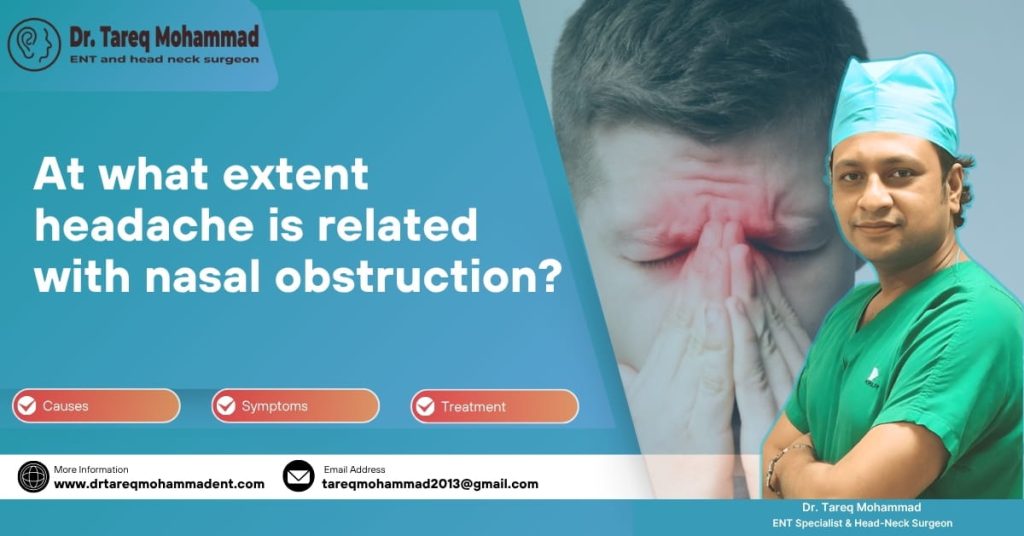
Have you ever wondered why your headache always seems to get worse when your nose is blocked? You are not alone. In my practice, I see patients almost every day who come in frustrated — they have been treating their headache for months with painkillers, not realizing that a blocked nose is the real culprit. The link between headache and nasal obstruction is stronger and more common than most people think, and understanding it can completely change how you find relief.
In this article, I will explain how nasal obstruction causes headaches, what conditions are behind it, how I evaluate and treat it, and — most importantly — when you need to see an ENT specialist right away.
Nasal obstruction simply means difficulty breathing through your nose — either partially or completely. When the nasal passages are blocked, airflow is disrupted, sinuses cannot drain properly, and pressure builds up inside the face and skull. That pressure is what you feel as a headache.
Think of your sinuses as a network of small, air-filled rooms connected to your nasal passages. When those passages are blocked, these rooms become congested — like a sealed bottle that cannot release pressure. The result is a dull, throbbing, or constant pain that can spread across your forehead, cheeks, the bridge of your nose, or even behind your eyes.
What makes this particularly tricky is that not all headaches related to nasal obstruction feel like a classic “sinus headache.” Some patients describe it as a tension-type headache, a deep facial ache, or pain that worsens when they bend forward. I have treated patients who were diagnosed with migraines for years, only to discover that a nasal structural problem was the underlying trigger.
In my experience treating ENT patients in Dhaka, the most frequent causes I encounter include:
✦Chronic sinusitis: Long-term inflammation of the sinuses leads to persistent blockage, mucus buildup, and continuous facial pressure or headache.
✦Deviated nasal septum (DNS): The wall dividing your two nostrils may be crooked from birth or after an injury. Even a moderate deviation can obstruct one or both sides and trigger recurrent headaches.
✦Nasal polyps: These are soft, non-cancerous growths inside the nasal passages. They block airflow and sinus drainage, causing both congestion and pressure headaches.
✦Allergic rhinitis: Seasonal or year-round allergies cause the nasal lining to swell, leading to congestion, sinus pressure, and headaches — especially in Bangladesh’s humid climate, where dust mites and mold are prevalent.
✦Turbinate hypertrophy: The bony structures inside the nose (turbinates) can become enlarged due to allergy or irritation, significantly narrowing the airway.
✦Nasal tumors or cysts (rare): Though uncommon, these can cause persistent one-sided obstruction and headache that does not respond to usual treatments.
Not every headache linked to nasal obstruction requires emergency care — but some warning signs demand prompt attention. I always tell my patients: do not wait if you experience any of the following.
✦Sudden, severe headache that feels like “the worst headache of your life”
✦Headache with high fever, stiff neck, or confusion
✦Headache following a head injury or facial trauma
✦Headache with vision changes, swelling around the eye, or eye redness
✦One-sided nasal obstruction with nosebleeds that do not stop
✦Headache that is steadily worsening over days or weeks without relief
These symptoms can indicate complications like a spreading sinus infection, orbital cellulitis, or, in rare cases, a more serious underlying condition. Please seek care immediately.
A precise diagnosis is the key to successful treatment.. When a patient comes to me with both headache and nasal obstruction, I follow a structured evaluation.
First, I take a thorough history — how long the symptoms have been present, whether they are triggered by seasons or allergens, and whether there is any facial trauma. Then I perform a nasal endoscopy, which allows me to look directly inside the nasal passages with a small camera. This simple, painless procedure gives me far more information than a basic examination.
✦CT scan of the paranasal sinuses — to visualize sinus inflammation, a deviated septum, polyps, or structural abnormalities in detail
✦Allergy testing — to identify environmental triggers contributing to chronic congestion
✦Acoustic rhinometry or rhinomanometry — to objectively measure how blocked the nasal passages are
The good news is that most causes of headache related to nasal obstruction are very treatable. My approach is always to start with the least invasive option and step up only when needed.
Medical (non-surgical) treatments include:
✦Nasal saline irrigation to wash out mucus and reduce congestion
✦Intranasal corticosteroid sprays to reduce swelling of the nasal lining
✦Antihistamines and allergen avoidance for allergic rhinitis
✦Antibiotics for bacterial sinusitis when appropriate
✦Leukotriene receptor antagonists for nasal polyp-related disease
✦Functional Endoscopic Sinus Surgery (FESS): A minimally invasive procedure to open blocked sinuses and restore normal drainage. I have performed this procedure on many patients in Dhaka with excellent outcomes.
✦Septoplasty: Surgical correction of a deviated nasal septum to restore airflow.
✦Turbinate reduction: A simple procedure to reduce the size of enlarged turbinates and widen the nasal airway.
✦Nasal polypectomy: Removal of nasal polyps when they are causing significant blockage or recurring headaches.
Many of my patients are surprised by how dramatically their headaches improve after treating the underlying nasal problem — often without needing any headache medication at all.
While structural problems like a deviated septum require medical intervention, there are steps you can take right now to reduce the severity of headaches linked to nasal congestion.
✦Use a saline nasal rinse (neti pot or spray) daily, especially during allergy seasons
✦Keep your home well-ventilated and use an air purifier to reduce dust and mold
✦Stay well-hydrated — adequate fluids help keep nasal secretions thin and drainage efficient
✦Avoid known allergens and irritants such as cigarette smoke, strong perfumes, and dust
✦Use a humidifier in air-conditioned rooms, as dry air worsens nasal congestion
✦Sleep with your head slightly elevated to reduce nighttime sinus congestion
✦Do not use decongestant nasal sprays for more than 3 days — prolonged use can worsen congestion (rebound congestion)
The relationship between headache and nasal obstruction is real, well-established, and — most importantly — treatable. Whether your headaches are caused by chronic sinusitis, a deviated septum, nasal polyps, or allergic rhinitis, there is an effective solution available to you. You do not need to keep living with unexplained pain or relying on painkillers that only mask the problem.
As an ENT specialist, I am committed to finding the root cause of your symptoms and providing you with a clear, personalized treatment plan. If your headaches are accompanied by any degree of nasal congestion or obstruction, please do not dismiss that connection — come and let me evaluate you properly.
You deserve answers — and real, lasting relief. Book your consultation with Dr. Tareq Mohammad today and take the first step toward breathing freely and living without pain.
 Call: +880 1537-240658
 Email: tareqmohammad2013@gmail.com
 Visit: Popular Medical College Hospital, Dhanmondi, House #25, Road No. 2, Dhaka 1205
Your health and comfort are my priority. I look forward to helping you feel like yourself again
Frequently Asked Questions
Can a blocked nose really cause a headache, or is it just a coincidence?
It is definitely not a coincidence. When the nasal passages are blocked, the sinuses cannot drain on ventilate properly, and this creates a pressure build-up that is felt as a headache. In my practice, I regularly find that patients who have had headaches for years see complete or near-complete resolution once we treat the underlying nasal obstruction. The two are closely connected and treating only the headache without addressing the nose is like treating smoke without putting out the fire
How do I know if my headache is from sinuses or from another cause like migraine?
This is a question I’m asked very often.. Sinus-related headaches are typically felt as a dull pressure or fullness in the forehead, cheeks, or around the nose, often made worse by bending forward, and usually accompanied by nasal congestion or discharge. Migraines, on the other hand are often one-sided, throbbing, and associated with nausea or sensitivity to light. However, there is significant overlap and research shows that many self-reported “sinus headaches” are actually migraines triggered by nasal congestion. A proper evaluation by an ENT specialist is the only reliable way to know for certain.
Will surgery for nasal obstruction definitely cure my headaches?
Surgery is not the answer for every patient, and I always explore non-surgical options first. However, when a structural problem like a severely deviated septum or large nasal polyps is confirmed as the cause of obstruction and headaches, surgery has a very high success rate in relieving symptoms. Many of my post-operative patients report not only better breathing but also a significant or complete reduction in their headache frequency. The key is having a thorough diagnosis before any decision about surgery is made.
Dr. Tareq Mohammad, MBBS, FCPS (ENT – Head & Neck Surgery), Assistant Professor at Popular Medical College Hospital, providing advanced ENT care with compassion and expertise.
© Copyright 2026 Dr. Tareq Mohammad - All Rights Reserved.
Need help? Team is just a message away