Child Snoring Adenoids – Causes, Signs & Treatment
Blog Single


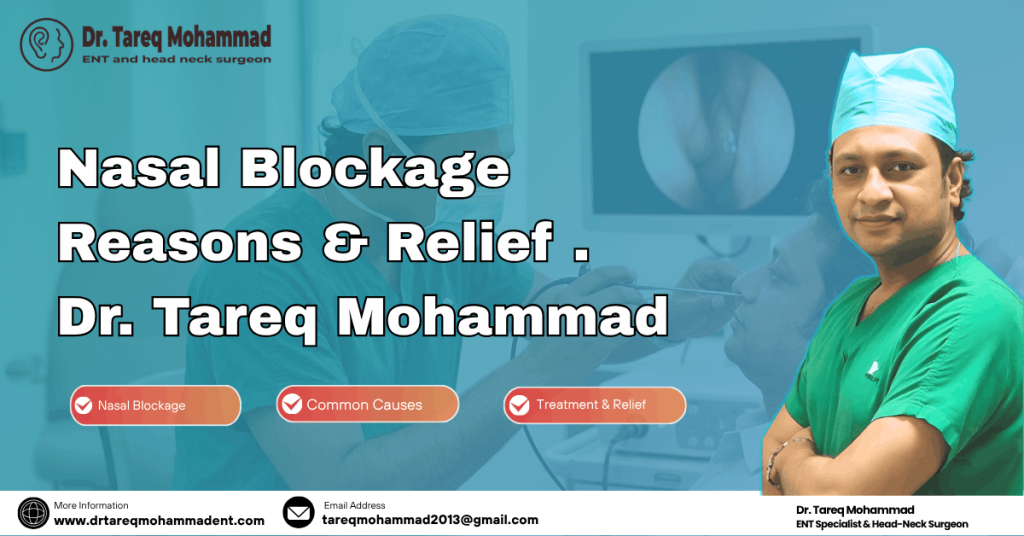
Few things are more exhausting than struggling to breathe freely through your own nose. In my practice as an ENT specialist, I meet patients every day who feel drained by a constant, stubborn nasal blockage. It disrupts your sleep, ruins your concentration, and sours your daily life. If you are tired of waking up with a dry mouth or feeling like you are constantly breathing through a pinched straw, I want to reassure you:
you do not have to just live with it. Let’s explore why this happens and how we can fix it together.
When we talk about a nasal blockage or a stuffy nose, most people assume their nasal passages are simply filled with thick mucus. While mucus is definitely part of the story, true congestion is actually caused by something else entirely.
Inside your nose is a delicate network of blood vessels. When these blood vessels become irritated, inflamed, and swollen, they expand into your breathing pathways. This swelling narrows the airspace, making it physically harder for air to flow through. In my clinic, I often describe it to patients as a traffic jam inside the nose; the road itself has narrowed, causing everything to back up.
Nasal stuffiness rarely travels alone. Depending on what is triggering your symptoms, you might experience a cluster of related issues. In my practice, I advise patients to keep track of these common warning signs:
✦Difficulty breathing through one or both nostrils, which often worsens when you lie down at night.
✦A persistent post-nasal drip, which is the sensation of mucus constantly dripping down the back of your throat.
✦Sinus pressure or a dull, throbbing ache around your forehead, eyes, and cheeks.
✦A reduced or completely lost sense of smell and taste.
✦Frequent, unexplained headaches or a feeling of heaviness in the face.
✦Loud snoring, mouth breathing, or waking up repeatedly throughout the night.
If you are dealing with a long-term blocked nose, finding the root cause is the first step toward recovery. Over my years of clinical experience treating patients in Dhaka, I have found that most cases of chronic nasal congestion boil down to a few primary culprits:
Our environment can be tough on our respiratory systems. Dust mites, pollen, mold, and seasonal changes trigger an overreaction in your immune system. This causes the lining of your nose to swell up and produce excess fluid.
The nasal septum is the thin wall of cartilage and bone that divides your nasal cavity into two equal halves. Ideally, it sits right down the middle. However, many patients I treat have a deviated septum, meaning this wall is leaned or shifted to one side. This structural imbalance permanently narrows one nasal passage, creating a constant physical obstruction.
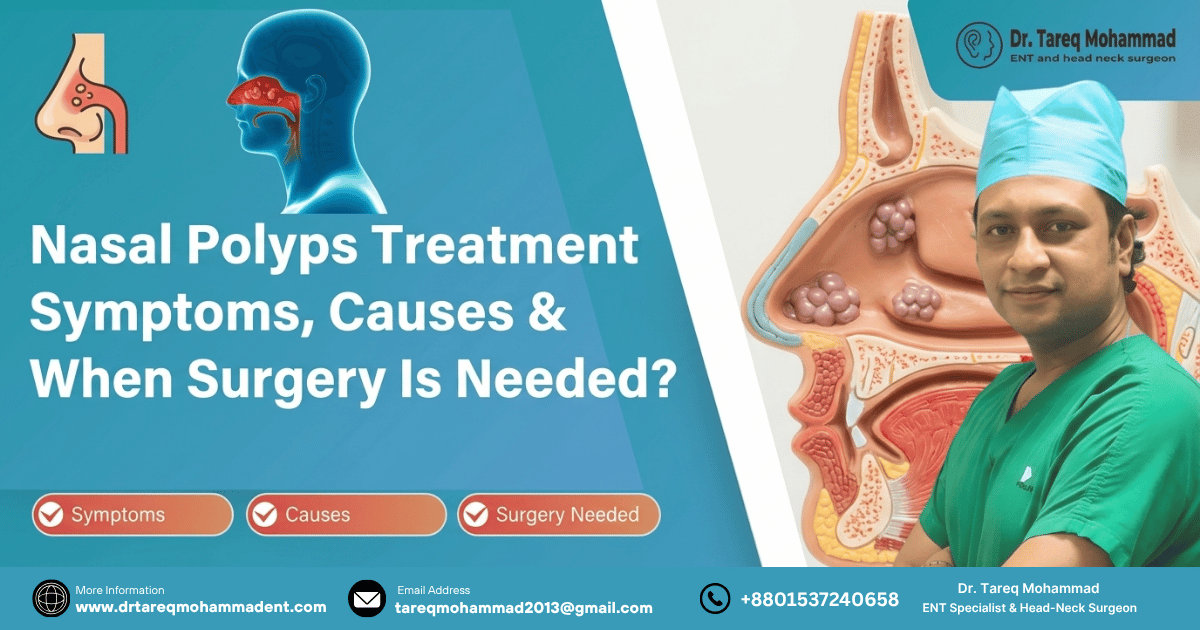
These are soft, non-cancerous, teardrop-shaped growths that develop on the lining of your nasal passages or sinuses. I often tell patients to think of them like tiny, swollen grapes. While small polyps might not cause issues, larger ones can completely block air passage and trap mucus.
Turbinates are small, shelf-like structures inside your nose that help warm, humidify, and filter the air you breathe. If they become chronically inflamed due to allergies or infections, they swell significantly and block the airway.
You cannot treat what you cannot clearly see. When you visit my chambers for a consultation, my goal is to pinpoint the exact structural or inflammatory cause of your discomfort.
My evaluation process is thorough yet gentle. I begin by listening carefully to your medical history and lifestyle factors. Next, I perform a physical examination using a specialized light to look inside your nostrils. For a deeper look, I often utilize a nasal endoscopy—a tiny, flexible camera that allows me to view the deep structures of your nasal passages on a high-definition monitor. If I suspect a deep-seated tissue issue or a complex structural problem, I may request a low-dose CT scan of your sinuses to map out your anatomy precisely.
Getting rid of a persistent block requires a personalized approach. There is no single “magic pill” because the treatment must match the underlying cause. Here are the primary ways we can achieve blocked nose relief:
✦Saline Nasal Sprays and Rinses: Washing your nasal passages with sterile saltwater helps clear out thick mucus, crusts, and allergens. It is a simple, drug-free way to soothe irritated tissues.
✦Medicated Nasal Sprays: Steroid sprays can significantly reduce tissue swelling if your block is caused by allergies or nasal polyps.
✦Antihistamines and Allergy Management: If allergies are the root cause, identifying your triggers and taking appropriate modern medications can dry up excess fluid and calm inflammation.
When medications fail to provide sufficient relief, or when we are dealing with a permanent structural deformity, a minor procedure or surgery can provide permanent, life-changing results.
✦Septoplasty: If a deviated septum is preventing you from breathing, this surgical procedure straightens the cartilage and bone, instantly opening up the airway.
✦Turbinate Reduction: This is a quick procedure where I use precise medical energy to shrink down the oversized, swollen tissues inside your nose without altering its natural structure.
✦Polypectomy: For patients burdened by large polyps, gently removing these growths restores normal airflow and prevents recurring sinus infection symptoms.
A temporary stuffy nose from a common cold usually clears up on its own within a week or two. However, you should not delay seeking professional care if you notice any of these more serious or persistent signs:
✦Your nasal blockage lasts longer than two to three weeks without any improvement.
✦You experience severe, sharp pain around your eyes or forehead that worsens over time.
✦You develop a high fever alongside your sinus symptoms.
✦You experience a thick, foul-smelling, or blood-stained discharge from only one side of your nose.
✦Your breathing difficulties are actively disrupting your sleep, leading to daytime fatigue.
Living with a persistent nasal blockage is exhausting, but you do not have to accept it as your normal state of health. Whether your breathing difficulties are caused by seasonal allergies, a structural shift like a deviated septum, or swollen tissue inside your nose, there is always a path toward clearer breathing. My absolute commitment is to listen to your story, find the exact cause of your discomfort, and design a treatment plan that fits your life.
If you are tired of struggling through blocked airways and sleepless nights, let’s find a permanent solution together. Schedule a comprehensive evaluation at my Dhaka clinic today.
📞 Call for Appointments: +8801537240658
📧 Email: tareqmohammad2013@gmail.com
📍 Visit My Chamber: Popular Medical College Hospital, Dhanmondi, House # 25, Road No. 2, Dhaka 1205
🌐 Book Online: Click Here to Schedule Your Appointment
Let’s clear your airways so you can focus on enjoying life to the fullest.
Q: Can using over-the-counter nasal decongestant sprays make my blockage worse?
Yes, absolutely. While over-the-counter decongestant sprays provide instant relief, using them for more than three to five consecutive days can trigger a condition called rhinitis medicamentosa. This is a “rebound effect” where your nasal tissues become dependent on the spray and swell up even worse whenever the medicine wears off.
Q: Is surgery always necessary to cure a chronic blocked nose?
Not at all. In my practice, surgery is always a carefully considered step, reserved for when conservative treatments fail. Many patients find excellent, long-term relief through targeted medical therapies, allergy management, and simple lifestyle adjustments. We only discuss structural procedures if there is a physical blockage, like a severely deviated septum or large polyps, that medicine cannot physically move.
Q: Can air pollution in Dhaka contribute to my constant nasal congestion?
Yes, urban air quality plays a massive role in upper respiratory health. Dust, exhaust fumes, and industrial particulates act as severe irritants to the nasal lining. This constant exposure causes the blood vessels in your nose to stay swollen and inflamed, mimicking a continuous allergy or cold.
Dr. Tareq Mohammad, MBBS, FCPS (ENT – Head & Neck Surgery), Assistant Professor at Popular Medical College Hospital, providing advanced ENT care with compassion and expertise.
© Copyright 2026 Dr. Tareq Mohammad - All Rights Reserved.
Need help? Team is just a message away