Child Snoring Adenoids – Causes, Signs & Treatment
Blog Single


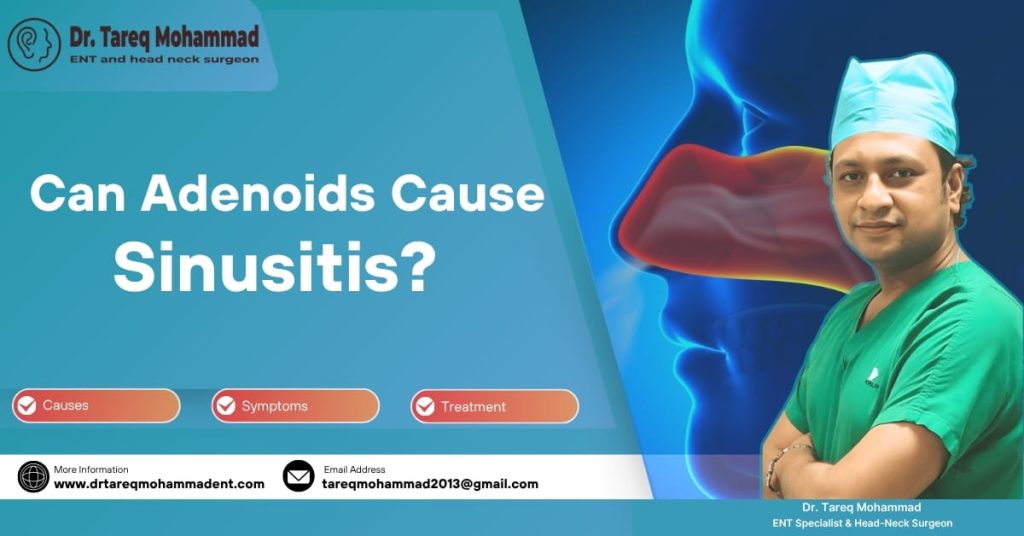
If your child — or even you — has been suffering from repeated sinus infections, a constantly blocked nose, or that nagging feeling of facial pressure, you may never have thought to look at the adenoids as the culprit. But in my ENT practice, I see this connection more often than most people expect. Yes, adenoids can absolutely cause or worsen sinusitis — and understanding why is the first step toward real, lasting relief. In this article, I’ll guide you through all the essential information you need to understand.
Adenoids are small, soft pads of tissue sitting at the back of the nasal passage, right where it meets the throat. Like the tonsils, they are part of the body’s immune system and help fight infections — especially during childhood.
The problem begins when adenoids become enlarged or chronically inflamed. When this happens, they partially block the normal airflow through the nose and, critically, they can obstruct the drainage pathways of the sinuses. Think of a busy drainage pipe with a sponge stuck inside it — fluid cannot flow freely, and problems build up quickly.
In children, adenoid enlargement (medically called adenoid hypertrophy) is extremely common. However, adults can be affected too, especially those with persistent allergies or recurrent upper respiratory infections.
This is one of the most common questions patients ask during consultations.. The short answer: enlarged adenoids create a perfect environment for sinus infections to develop and keep coming back.
Here is how it works:
✦ Blocked nasal drainage: The sinuses continuously produce mucus that needs to drain through small openings into the nasal cavity. Enlarged adenoids obstruct this area, trapping mucus inside the sinuses.
✦ Bacterial breeding ground: Stagnant, trapped mucus becomes an ideal place for bacteria and viruses to grow — triggering sinus infections repeatedly.
✦ Chronic inflammation: The persistent obstruction leads to ongoing inflammation of the sinus lining, which is the definition of chronic sinusitis.
✦ Mouth breathing: Adenoid enlargement often forces patients to breathe through their mouths, drying out the throat and nasal passages and reducing the natural defenses against infection.
In my practice, I have treated many children who were diagnosed with chronic sinusitis for months — sometimes years — before discovering that swollen adenoids were the root cause that had been missed.
Recognizing the combined symptoms of adenoid problems and sinusitis can help you seek the right care sooner. Watch for the following signs:
Sinusitis symptoms:
✦ Facial pain or pressure (especially around the cheeks, eyes, and forehead)
✦ Thick yellow or green nasal discharge
✦ Postnasal drip — a condition where mucus flows down the back of the throat.
✦ Reduced or lost sense of smell
✦ Frequent headaches
Adenoid-related symptoms:
✦ Persistent blocked or stuffy nose, even without a cold
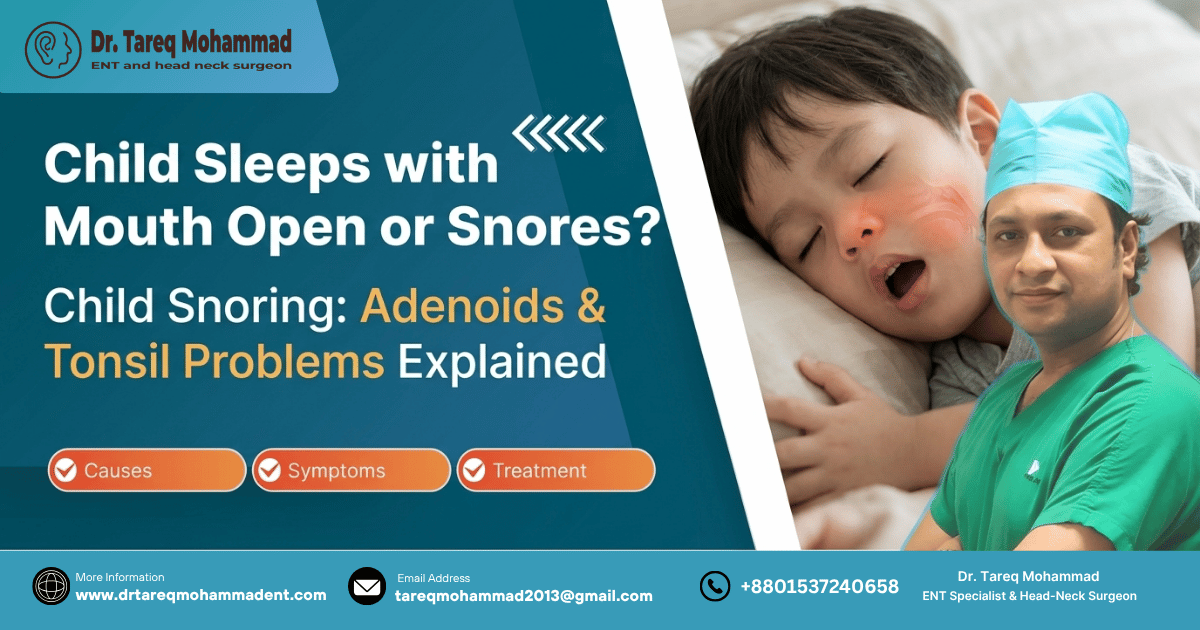
✦ Loud snoring or noisy breathing at night
✦ Mostly breathing through the mouth instead of the nose.
✦ Recurrent ear infections or “glue ear” (fluid behind the eardrum)
✦ Nasal voice or speaking as if pinching the nose
In children specifically, I also look for:
✦ Restless or poor-quality sleep
✦ Daytime fatigue or difficulty concentrating at school
✦ A pattern of repeated chest or throat infections
If you or your child have several of these symptoms together, it is time to have a proper ENT evaluation.
When a patient comes to me with recurring sinusitis, I never stop at treating the sinus infection alone. I always look for an underlying cause.
My diagnostic approach typically includes:
✦ Nasal endoscopy — A small, thin camera gently passed into the nose to directly visualize the adenoids, nasal passages, and sinus openings. This is the gold standard for assessment and is well-tolerated even by children.
✦ CT scan of the sinuses — Provides a detailed image of the sinuses, showing inflammation, fluid, and any structural blockages.
✦ Lateral neck X-ray — A simpler, cost-effective imaging option used especially for children to assess adenoid size.
✦ Allergy testing — Since allergies are a major driver of adenoid enlargement, I check for this in many patients.
I believe accurate diagnosis is the foundation of effective treatment. Without identifying the root cause, patients often go through repeated courses of antibiotics that provide only temporary relief.
The good news is that once we identify adenoids as the cause of recurring sinusitis, treatment becomes much more targeted and effective.
Conservative (Non-Surgical) Treatment:
I always start with non-surgical options when appropriate:
✦ Nasal corticosteroid sprays — These reduce adenoid and nasal inflammation significantly. I recommend them as a first-line treatment for mild to moderate adenoid enlargement.
✦ Saline nasal rinses — Daily rinsing helps flush out mucus and reduce bacterial load in the nasal passages.
✦ Antihistamines — Essential when allergies are driving the enlargement.
✦ Antibiotics — Used only when there is an active bacterial sinus infection confirmed clinically or by culture.
Surgical Treatment — Adenoidectomy:
When conservative treatments fail or when the adenoids are severely enlarged, surgical removal of the adenoids (adenoidectomy) is highly effective and often life-changing for patients.
In my experience, adenoidectomy:
✦ Reduces the frequency of sinus infections dramatically
✦ Improves nasal breathing almost immediately
✦ Improves sleep quality and daytime energy
✦ Often resolves recurrent ear infections in children
The procedure is safe, quick (usually 20–30 minutes), and performed under general anaesthesia. Recovery is generally smooth, with most children returning to school within a week.
When sinusitis is severe and sinuses themselves are blocked, I may also recommend Functional Endoscopic Sinus Surgery (FESS) alongside adenoidectomy to open the sinus drainage pathways directly.
Please do not wait for a long time before seeking expert care. I recommend booking an ENT consultation if:
✦ Your child has had 3 or more sinus infections in a single year
✦ Sinus symptoms have lasted more than 12 weeks despite treatment
✦ Your child snores loudly, wakes frequently at night, or seems always tired
✦ Nasal blockage is constant and not improving with medication
✦ You or your child are taking repeated antibiotics with only short-term improvement
✦ There are associated ear problems or hearing difficulties
Early evaluation almost always leads to better outcomes and avoids years of unnecessary suffering.
While not every case is preventable, these practical steps can help reduce the severity of adenoid-related sinus problems:
✦ Keep your home clean and reduce dust, mould, and pet allergens
✦ Use a cool-mist humidifier to keep nasal passages moist, especially in air-conditioned rooms
✦ Encourage regular handwashing to reduce respiratory infections in children
✦ Ensure your child receives appropriate vaccinations, including the annual influenza vaccine
✦ Practice daily saline nasal rinsing if recurrent infections are a problem
✦ Avoid cigarette smoke exposure, which worsens both adenoid inflammation and sinusitis
Do not let sinusitis keep disrupting your life or your child’s well-being. I am here to help you get the right answers and the right treatment.
📞 Call: +8801537240658
📧 Email: tareqmohammad2013@gmail.com
📍 Visit: Popular Medical College Hospital, Dhanmondi, House #25, Road No. 2, Dhaka 1205
🌐 Book your consultation
Your health and your family’s comfort matter deeply to me. Reach out today — a clearer, healthier future is just one consultation away.
Adenoids and sinusitis are more closely connected than many people realise. If you or your child have been dealing with recurring sinus infections, a blocked nose that never fully clears, or poor sleep from nasal obstruction, enlarged adenoids may be at the root of it all. With the right diagnosis and the right treatment — whether medical or surgical — real and lasting relief is absolutely possible. In my practice, I am committed to finding that root cause and guiding every patient toward the best outcome with compassion and expertise.
Q1: Can adults have enlarged adenoids that cause sinusitis?
Yes, absolutely. While adenoid problems are far more common in children, I do see adult patients — particularly those with chronic allergies or frequent respiratory infections — who have persistently enlarged adenoid tissue causing chronic sinusitis. It is less commonly considered in adults, which is why a thorough nasal endoscopy is so important for anyone with unexplained chronic sinusitis.
Q2: Will my child outgrow the adenoid problem without surgery?
In some mild cases, adenoids do shrink naturally as children grow older, usually by early teenage years. However, if your child is suffering from recurrent sinus infections, poor sleep, or hearing difficulties now, waiting is rarely the right approach. I assess each child individually — for some, medication is enough; for others, adenoidectomy provides relief that simply cannot wait. Early treatment prevents years of missed sleep and missed school.
Q3: How soon after adenoidectomy will sinus infections improve?
In my experience, most patients notice a significant reduction in sinus infections within the first few months after surgery. Nasal breathing often improves within the first few weeks. Some patients — particularly those with very established chronic sinusitis — may need additional sinus treatment, but the overall outcome after adenoidectomy for adenoid-related sinusitis is excellent.
Dr. Tareq Mohammad, MBBS, FCPS (ENT – Head & Neck Surgery), Assistant Professor at Popular Medical College Hospital, providing advanced ENT care with compassion and expertise.
© Copyright 2026 Dr. Tareq Mohammad - All Rights Reserved.
Need help? Team is just a message away