Child Snoring Adenoids – Causes, Signs & Treatment
Blog Single


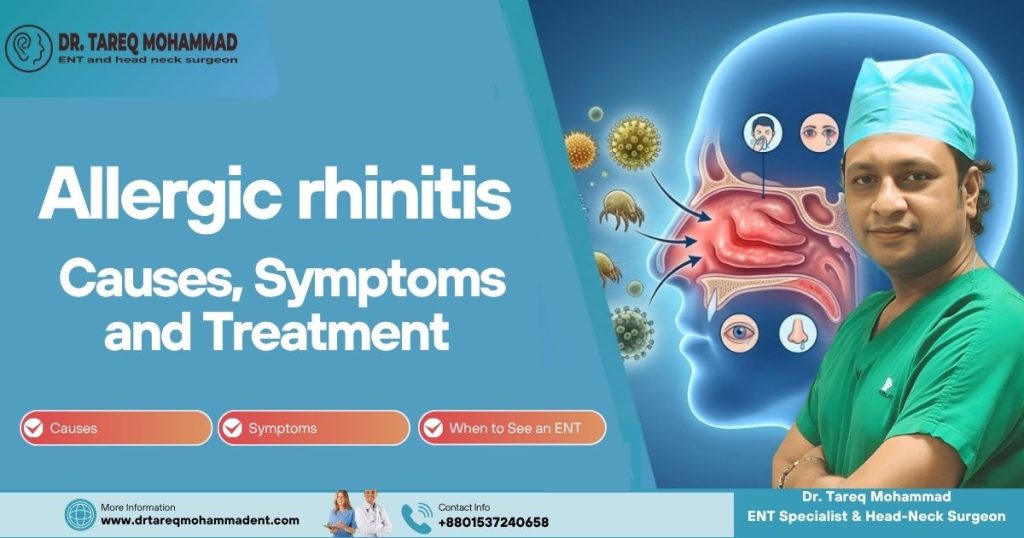
In my practice, allergic rhinitis is one of the most common reasons patients come to see me. Most people describe it the same way — constant sneezing, a runny or blocked nose, and itchy eyes that never seem to fully go away. Many assume they have a lasting cold. Once I explain what’s actually happening, it usually makes a lot more sense to them.
Allergic rhinitis happens when the lining inside your nose overreacts to something in the environment that isn’t actually harmful — like pollen, dust mites, pet dander, or mold. Your immune system mistakenly treats this substance as a threat and releases a chemical called histamine, which causes the swelling, irritation, and mucus production you feel.
It isn’t an infection, and it isn’t contagious. That’s the main difference between allergic rhinitis and a common cold, even though the symptoms can look similar at first.
The trigger — called an allergen — varies from patient to patient. The most common ones I see are:
✦Pollen from trees, grass, or weeds
✦Dust mites in bedding and carpets
✦Mold spores in humid environments
✦Pet fur and dander
✦Smoke, strong perfumes, or air pollution
Some patients react to one specific trigger. Others react to several, which makes the condition feel like it never fully goes away.
I usually explain to my patients that allergic rhinitis falls into two broad types:
Seasonal allergic rhinitis flares up during specific times of year, typically linked to pollen from flowering plants or grass.
Perennial allergic rhinitis occurs year-round and is usually caused by indoor allergens like dust mites, mold, or pets — things people are exposed to constantly.
Knowing which type you have changes how we approach treatment, since avoiding a year-round trigger is very different from avoiding a seasonal one.
The symptoms I look for during an evaluation include:
✦Repeated sneezing, especially in the morning
✦Runny or blocked nose
✦Itchy nose, throat, or roof of the mouth
✦Watery, itchy, or red eyes
✦Postnasal drip and mild throat irritation
✦Reduced sense of smell in longer-standing cases
What causes nasal obstruction in allergic rhinitis?
The nasal lining swells in response to histamine release, narrowing the airway and making it harder to breathe through the nose, particularly at night.
If congestion is severe or one-sided, I also check whether a structural issue is contributing — you can read more about that in our article on causes of nasal obstruction.
When I evaluate a patient with this problem, I start with a detailed history — timing of symptoms, possible triggers, and family history of allergies, since allergic conditions often run in families. A nasal endoscopy lets me directly examine the nasal lining and rule out other causes such as polyps or a deviated septum. In some cases, allergy testing helps confirm the specific trigger, particularly when symptoms are severe or don’t respond to initial treatment.
There’s no single “cure” for allergic rhinitis, but it can be managed very effectively. The right combination depends on how severe your symptoms are and how much they affect your daily life.
Avoiding known triggers is the first and most effective step whenever it’s practical — reducing dust exposure, using allergen-proof bedding covers, or keeping pets out of the bedroom.
Antihistamines reduce sneezing, itching, and runny nose by blocking the histamine response.
Nasal corticosteroid sprays are often the most effective option for ongoing congestion, since they directly reduce inflammation in the nasal lining.
Saline nasal rinses help clear allergens and mucus and are safe for regular use.
Immunotherapy (allergy shots or tablets) is considered for patients with persistent, well-confirmed allergies who don’t respond adequately to standard treatment. This works gradually, over months, to reduce the immune system’s sensitivity to a specific allergen.
I don’t recommend surgery for allergic rhinitis itself, though it may be considered separately if a structural problem such as a deviated septum or nasal polyps is also present and contributing to blockage.
You can’t always prevent allergic rhinitis entirely, especially with seasonal pollen, but you can reduce flare-ups by identifying your specific triggers and limiting exposure where possible — keeping windows closed during high-pollen periods, washing bedding regularly, and using air filters in dusty environments.
I recommend seeing a specialist if your symptoms last more than a few weeks, interfere with sleep or daily activities, don’t improve with over-the-counter antihistamines, or if you notice one-sided congestion, facial pain, or a reduced sense of smell — these can point to something beyond allergic rhinitis that needs a closer look.

Assistant Professor, Department of ENT & Head-Neck Surgery, ENT & Head-Neck Specialist
Chamber: Popular Medical College Hospital, Dhanmondi, Dhaka
Contact :+8801537240658
Website: https://drtareqmohammadent.com/
If you’ve noticed gradual hearing loss or a family history of similar issues, an ENT evaluation can clarify what’s happening and what your options are. You can book a consultation with Dr. Tareq Mohammad at Popular Medical College Hospital, Dhanmondi, Dhaka, through the contact details above.
Is allergic rhinitis the same as a cold?
No. A cold is caused by a viral infection and usually resolves within a week or two. Allergic rhinitis is triggered by allergens, not infection, and symptoms can persist as long as you’re exposed to the trigger.
Can allergic rhinitis be cured permanently?
There’s no permanent cure, but symptoms can be controlled very effectively with trigger avoidance, medication, and in some cases immunotherapy.
Is allergic rhinitis dangerous?
It isn’t life-threatening, but untreated symptoms can affect sleep, concentration, and quality of life, and can sometimes contribute to sinus infections or worsen asthma.
Can children develop allergic rhinitis?
Yes, it’s very common in children, especially if there’s a family history of allergies, asthma, or eczema.
Do I need allergy testing?
Not always. Testing is most useful when symptoms are severe, persistent, or don’t respond to initial treatment, so we can confirm the exact trigger.
Can allergic rhinitis lead to sinusitis?
Yes, ongoing nasal swelling and blocked drainage from allergic rhinitis can increase the risk of sinus infections. Our article on nasal congestion and headaches covers this connection in more detail.
Is surgery ever needed for allergic rhinitis?
Not for the allergy itself. Surgery is only considered if a separate structural issue, like a deviated septum or nasal polyps, is also present and contributing to blockage.

Dr. Tareq Mohammad, MBBS, FCPS (ENT – Head & Neck Surgery), Assistant Professor at Popular Medical College Hospital, providing advanced ENT care with compassion and expertise.
© Copyright 2026 Dr. Tareq Mohammad - All Rights Reserved.
Need help? Team is just a message away