Child Snoring Adenoids – Causes, Signs & Treatment
Blog Single


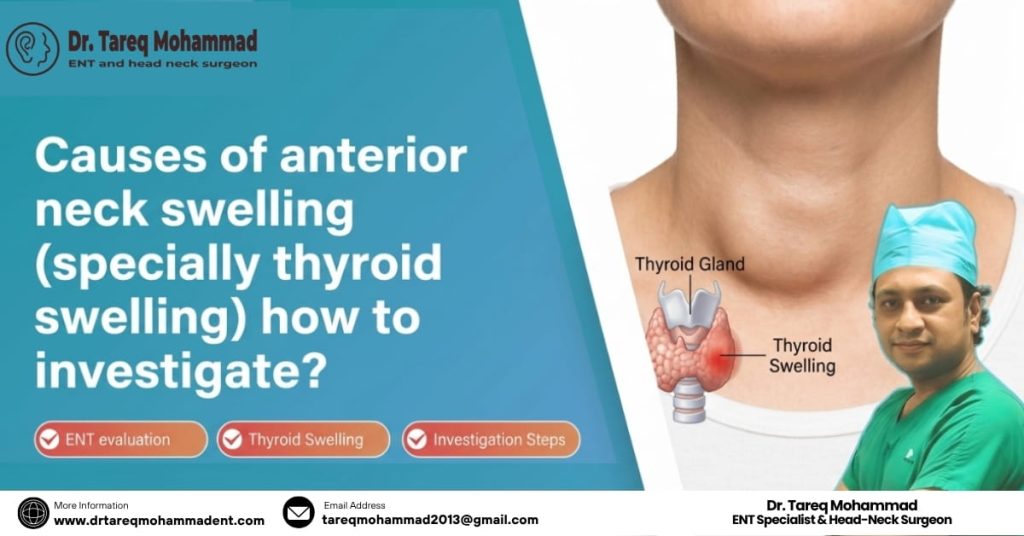
An anterior neck swelling is any abnormal lump or enlargement located at the front of the neck, most commonly originating from the thyroid gland. While a majority of these swellings are benign (non-cancerous) goiters or cysts, a systematic medical evaluation including blood tests, imaging, and a tissue sample is vital to rule out malignancy and plan proper treatment.
The most frequent cause of an anterior neck swelling is a thyroid disorder, such as a multi-nodular goiter, thyroid cyst, or thyroiditis. Non-thyroid causes include thyroglossal duct cysts and enlarged lymph nodes. Diagnosis requires a clinical ENT examination, Thyroid Function Tests (TFTs), a high-resolution neck ultrasound, and a Fine Needle Aspiration Cytoscopy (FNAC) to assess for potential malignancy.
✦The majority of front-of-neck swellings are related to the thyroid gland and are benign.
✦A localized, moving lump when you swallow is a classic sign of a thyroid swelling.
✦An ultrasound scan and a simple needle biopsy (FNAC) are the gold standards for initial investigation.
✦Early assessment by an ENT specialist eliminates anxiety and prevents potential complications.
✦Comprehensive, expert care for neck lumps is readily accessible at my clinic in Dhaka, Bangladesh.
Noticing a lump or a sudden fullness at the front of your throat can be an alarming experience. In my daily clinical practice as an ENT and Head-Neck Surgeon, anterior neck swelling is one of the most common complaints patients present with. It is completely natural to feel anxious, but it is important to know that most front-of-neck swellings are highly treatable, and many turn out to be completely harmless.
The primary goal of this guide is to clear the confusion surrounding these lumps. We will look closely at why they form—especially regarding thyroid swelling causes—and walk through the exact medical step-by-step evaluation process I use to ensure my patients receive an accurate, stress-free diagnosis.
An anterior neck swelling refers to any visible or palpable mass located within the front triangle of the neck. This area is bounded by the jawline above, the breastbone below, and the large muscles on either side of the neck.
The most common occupant of this anatomical region is the thyroid gland—a butterfly-shaped organ responsible for regulating your body’s metabolism. When this gland enlarges, it is medically termed a goiter. Swellings here can affect anyone, from young adults dealing with developmental cysts to older individuals developing thyroid nodules. In my practice here in Dhaka, I regularly evaluate patients of all ages, helping them understand whether their lump is a localized thyroid nodule or a generalized swelling.
While the swelling itself is the most obvious sign, it rarely appears in total isolation. Depending on what is causing the lump, you might experience a variety of accompanying symptoms.
Common accompanying signs include:
✦A visible bulge that moves visibly up and down when you swallow.
✦A persistent feeling of tightness or a “lump in the throat” sensation.
✦Unexplained weight loss or weight gain accompanied by fatigue.
✦Feeling unusually hot or cold compared to people around you.
Red Flag Symptoms (Require Immediate Evaluation):
✦Rapid, noticeable growth of the neck mass over a few weeks.
✦A persistent hoarse voice or changes in your speech.
✦Difficulty swallowing solid foods or liquids.
✦Shortness of breath or a choking sensation when lying flat.
✦Hard, fixed lumps that do not move easily when touched.
Common Causes of Anterior Neck Swelling
When a patient walks into my clinic with a midline or front neck mass, we look at several potential culprits. Let’s break down the primary thyroid swelling causes and other regional issues.
By far, the most frequent reason for an enlargement is a simple or multi-nodular goiter. These are non-cancerous overgrowths of normal thyroid tissue. Sometimes, a fluid-filled pocket called a thyroid cyst develops. In my clinical experience, these are often linked to nutritional factors like dietary iodine imbalances or genetic predispositions.
Inflammation of the thyroid gland can cause it to swell up quickly. Conditions like Hashimoto’s thyroiditis or subacute thyroiditis can make the gland tender to the touch and can temporarily disrupt your body’s hormone balance, leading to fatigue and neck discomfort.
This is a developmental condition. A thyroglossal duct cyst forms along the path that the thyroid gland took when you were developing before birth. It typically presents as a smooth, round midline neck swelling that characteristically moves upward when you stick your tongue out.
While less common, a solid, fast-growing thyroid nodule must always be evaluated for malignancy. Early thyroid cancer screening via precise clinical workups ensures that if a tumor is present, it can be treated surgically with an exceptionally high cure rate.
Sometimes the swelling isn’t the thyroid at all, but rather lymph nodes responding to an upper respiratory tract infection, dental issue, or other regional inflammation.
An accurate evaluation of thyroid swelling cannot rely on visual inspection alone. I guide my patients through a structured, evidence-based roadmap to determine exactly what is happening under the skin.
Everything starts with a thorough physical examination. I will gently palpate your neck while you swallow to feel the consistency, size, and movement of the mass. If you are experiencing voice changes, I will perform a quick, painless Nasal Endoscopy in the clinic to look directly at your vocal cords and ensure the nerves traveling near the thyroid are working perfectly.
We need to know how well your gland is working. We measure the levels of hormones in your blood, specifically T3, T4, and Thyroid Stimulating Hormone (TSH). This tells us if your body is in a state of hyperthyroidism (overactive) or hypothyroidism (underactive).
This non-invasive imaging test uses sound waves to create a clear picture of the inside of your neck. A thyroid ultrasound evaluation helps me see if a lump is solid or fluid-filled, measures its exact dimensions, and identifies specific features that might suggest whether it is benign or requires a biopsy.
If the ultrasound reveals a solid nodule with suspicious features, a Fine Needle Aspiration Cytology (FNAC) of thyroid is performed. Using a microscopic needle, a tiny sample of cells is collected from the lump. This sample is examined by a pathologist to definitively determine if the tissue is benign or malignant.
Once our investigation of neck lump is complete, we tailor a treatment plan unique to your diagnosis. Treatment generally falls into four main pathways:
If your swelling is caused by an underactive thyroid (hypothyroidism) or an inflammatory condition like thyroiditis, daily hormone replacement medications or anti-inflammatory drugs are highly effective in stabilizing your hormone levels and reducing the size of the gland.
For mild, non-progressive goiters related to dietary patterns, optimizing your intake of essential elements like iodine and selenium can support overall thyroid health. Managing chronic stress also plays a positive role in metabolic stability.
While home treatments cannot shrink a physical structural nodule, using warm compresses can soothe local muscular discomfort or tenderness caused by acute thyroid inflammation. However, remedies should never replace a formal medical evaluation.
As a Head-Neck surgeon, I recommend surgery (thyroidectomy) under specific circumstances. If the FNAC confirms or strongly suspects thyroid cancer, if the goiter grows large enough to compress your windpipe or esophagus, or if it causes significant cosmetic distress, removing part or all of the gland is the safest and most definitive option.
You should schedule a consultation the moment you notice a persistent, unexplained lump in your neck that lasts longer than two to three weeks. Waiting too long introduces unnecessary risks. If a lump happens to be malignant, a delayed diagnosis limits treatment options. Conversely, if it is benign but growing, it becomes more complex to operate on later. Seeking early attention from an ENT specialist in Dhaka ensures peace of mind and timely intervention.
Presenting Symptom | Most Likely Underlying Cause | Initial Diagnostic Step |
Smooth midline lump moving with tongue protrusion | Thyroglossal Duct Cyst | Ultrasound of the Neck |
Multi-bumped mass moving only with swallowing | Multi-Nodular Goiter | Thyroid Function Tests (TFTs) |
Rapidly growing, hard, fixed, painless lump | Malignancy / Thyroid Cancer | Ultrasound + FNAC |
Tender, painful swelling with fever and exhaustion | Subacute Thyroiditis | Blood Tests (ESR, CRP, TFTs) |
Multiple small, tender lumps on the side of the neck | Reactive Lymphadenopathy | Clinical ENT Exam |
Treatment Option | Primary Medical Indication | Major Patient Benefit |
Thyroid Hormone Therapy | Hypothyroidism / Shrinking small goiters | Non-invasive, restores baseline energy levels |
Surgical Removal (Thyroidectomy) | Malignancy, airway compression, large goiter | Definitive cure, eliminates compression symptoms |
Observation & Monitoring | Small, non-cancerous, stable benign nodules | Avoids unnecessary procedures or medications |
Anti-inflammatory Medication | Acute or subacute painful thyroiditis | Rapid relief from neck pain and tenderness |
✦WhatsApp: +8801537240658
✦Location: Popular Medical College Hospital, House #25, Road #2, Dhanmondi,
Dhaka 1205, Bangladesh.
If you have noticed a new lump, a persistent feeling of throat heaviness, or visible changes at the front of your neck, please do not ignore it or delay your evaluation. Getting an expert opinion early is the best way to safeguard your long-term health.
📞 Call to Action: +8801537240658
📧 Email Inquiries: tareqmohammad2013@gmail.com
📍 Visit Clinic: Popular Medical College Hospital, Dhanmondi, Dhaka
🌐 Secure Your Slot: Book an Appointment with Dr. Tareq Mohammad
Your health and peace of mind are always our highest priorities. Reach out to our dedicated team today to schedule your comprehensive neck evaluation.
Question: How can I tell if my neck swelling is my thyroid or a lymph node?
Answer: A classic identifying feature of a thyroid swelling is that it is located in the lower midline or just beside the windpipe and will distinctly move upward when you swallow. Lymph nodes are typically located on the sides of the neck, feel like small beans, and do not move when you swallow.
Question: Is an FNAC test for a thyroid nodule painful?
Answer: An FNAC is a very quick, outpatient procedure that feels similar to a standard blood draw. It uses a highly specialized needle that is thinner than a typical injection needle. Most patients tolerate it exceptionally well without needing local anesthesia, experiencing only mild pressure for a few seconds.
Question: Can stress cause my thyroid gland to swell up?
Answer: While emotional or physical stress does not directly cause physical structural nodules or goiters to grow, chronic stress profoundly impacts your immune system. This can exacerbate underlying autoimmune thyroid disorders like Hashimoto’s thyroiditis, which can lead to gland inflammation and secondary swelling.
Question: If I need thyroid surgery, will I lose my voice?
Answer: Temporary voice weakness can occasionally occur due to tissue bruising. However, as an experienced head and neck surgeon, I use meticulous surgical techniques to carefully locate and preserve the recurrent laryngeal nerves that control your vocal cords, reducing the risk of permanent voice changes to an absolute minimum.
Question: Are most anterior neck lumps cancerous?
Answer: No, the vast majority—roughly 85% to 90% of all checked anterior neck and thyroid masses—turn out to be completely benign conditions such as cysts, inflammatory changes, or simple fluid collections. However, an accurate diagnostic workup remains essential to identify the few cases that do require targeted cancer care.

Dr. Tareq Mohammad, MBBS, FCPS (ENT – Head & Neck Surgery), Assistant Professor at Popular Medical College Hospital, providing advanced ENT care with compassion and expertise.
© Copyright 2026 Dr. Tareq Mohammad - All Rights Reserved.
Need help? Team is just a message away