Child Snoring Adenoids – Causes, Signs & Treatment
Blog Single


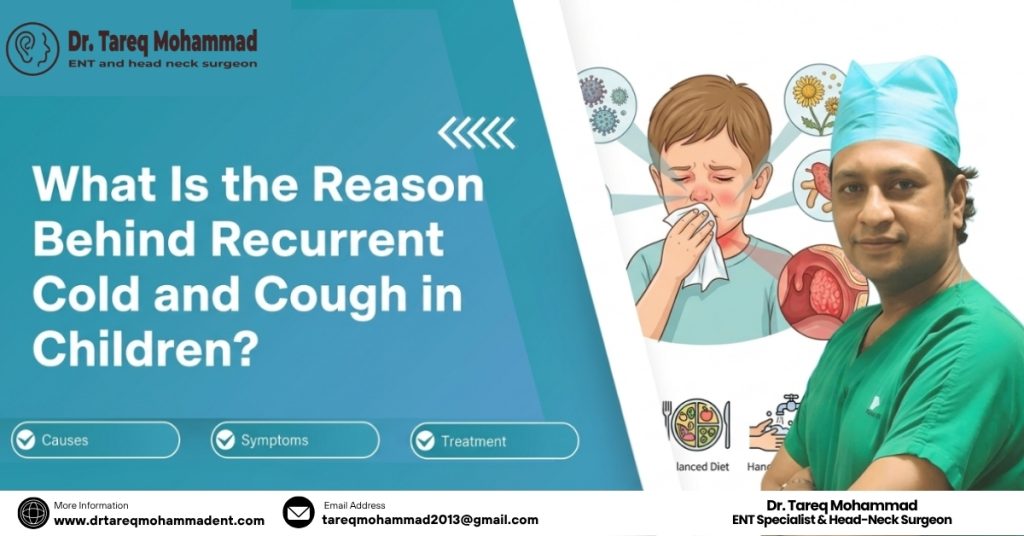
Recurrent cold and cough in children is most commonly caused by frequent viral upper respiratory infections as their immune systems develop. However, underlying factors like seasonal allergies, enlarged adenoids, asthma, environmental triggers, or chronic sinus infections often turn a simple cold into a persistent cough in children.
The primary reason behind a recurrent cold and cough in children is exposure to multiple distinct respiratory viruses in school or daycare settings while their immune systems are still maturing. When these symptoms are continuous, the underlying causes are usually seasonal allergies, hyperreactive airways (asthma), enlarged adenoids blocking nasal passages, or second-hand smoke exposure.
✦It is normal for healthy young children to experience 6 to 8 colds per year.
✦Allergies causing recurrent cough in children often mimic long-lasting colds.
✦Enlarged adenoids can trap infections, causing persistent nasal blockage and frequent throat infections.
✦Environmental triggers like dust, pollution, and secondhand smoke significantly prolong a chronic cough in kids.
✦Consulting a pediatric ENT specialist for recurrent cough ensures an accurate diagnosis and targeted treatment plan.
As a parent, watching your little one struggle with a stuffy nose and a relentless cough is incredibly heartbreaking. In my daily clinical practice as an ENT specialist in Dhaka, one of the most frequent complaints I hear from anxious parents is, “Why does my child get colds frequently?” It feels like as soon as one cold clears up, a new child with a repeated cough and cold takes its place.
Understanding the underlying reason behind a recurrent cold and cough in children is essential to helping them recover fully. While young children naturally catch multiple viral infections a year, persistent or severe episodes often point to structural or allergic issues. In this comprehensive guide, I will break down the common causes, warning signs, and the best treatment for recurrent cold and cough in children based on modern medical guidelines.
When we talk about a recurrent cold and cough in children, we are looking at a pattern of frequent upper respiratory infections or long-lasting respiratory symptoms. Medically, it is entirely normal for healthy toddlers and school-going children to experience 6 to 10 respiratory episodes a year, especially if they attend daycare. Each episode can last for 1 to 2 weeks.
However, when these infections happen back-to-back without a period of complete recovery, or if a persistent cough in children stretches past 4 weeks, it transitions into a chronic cough in kids. This pattern requires a closer look by an ENT specialist to distinguish normal immune building from underlying medical conditions.
While a standard cold involves a clear runny nose, mild fever, and a temporary cough, certain symptoms indicate that your child’s recurrent upper respiratory tract infections might be driven by something more complex.
Look out for these common signs:
✦Continuous nasal blockage in children that lasts for weeks.
✦Frequent throat infections in children accompanied by difficulty swallowing.
✦A wet or dry persistent cough in children that worsens at night or during exercise.
✦Breathing through the mouth rather than the nose, especially while sleeping.
✦Loud snoring or periods of paused breathing during sleep (sleep apnea).
✦Recurrent ear pain or fluid draining from the ear.
✦Unexplained fatigue, irritability, and poor weight gain.
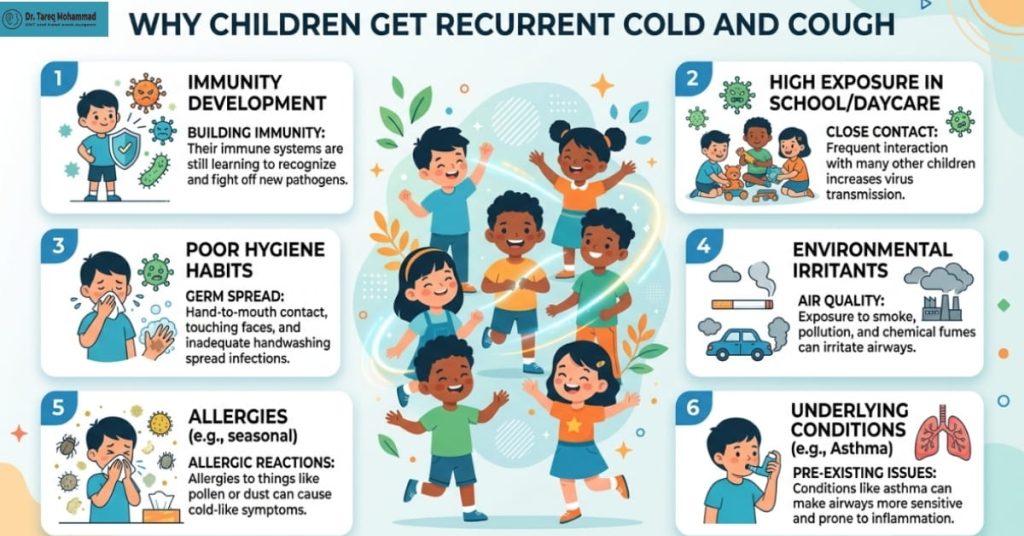
Based on my clinical experience treating young patients in Bangladesh, a cycle of continuous illness is rarely just “bad luck.”
Here are the primary causes of recurrent cold and cough in children:
Young children possess what parents often mistake for a weak immunity in children. In reality, their immune systems are simply “uneducated.” When kids enter preschool or daycare, they are exposed to hundreds of novel viruses. Their bodies must fight each one off individually to build immunity, resulting in frequent cold in kids.
Allergies causing recurrent cough in children are incredibly common. When a child is sensitive to dust mites, pollen, mold, or pet dander, their nasal passages become chronically inflamed. This mimics a perpetual cold, complete with clear nasal discharge, sneezing, and a post-nasal drip that triggers a persistent cough.
The adenoids are small patches of tissue located high up in the back of the throat, right behind the nose. In many children, frequent infections cause these tissues to swell. Enlarged adenoids in children block the natural drainage of the nose and sinuses, trapping mucus and bacteria. This structural blockage results in permanent nasal blockage, mouth breathing, snoring, and a repeated cough.
Asthma and recurrent cough in children go hand in hand. Often, a viral cold triggers an exaggerated inflammatory response in a child’s lower airways. If your child’s cough is dry, hacking, and worsens with physical activity, cold air, or crying, it may be a sign of cough-variant asthma rather than a simple cold.
If a simple cold is left untreated, or if structural issues prevent proper drainage, a bacterial sinus infection in children can develop. This leads to a thick, discolored nasal discharge, facial pressure, and a lingering daytime and nighttime cough caused by mucus dripping down the back of the throat.
When you bring your child to my clinic at Popular Medical College Hospital in Dhaka, my primary goal is to find the exact root cause of their frequent illness. A standard physical examination is rarely enough for chronic cases.
✦Detailed Clinical History: We discuss the frequency of the illnesses, environmental exposures, allergy history, and sleep habits.
✦Diagnostic Nasal Endoscopy: Using a tiny, specialized pediatric endoscope, I can painlessly examine the inside of your child’s nasal passages. This allows me to directly check for enlarged adenoids, nasal polyps, or physical blockages.
✦Allergy Testing: If we suspect seasonal allergies in children, specific skin prick tests or blood tests can pinpoint environmental triggers.
✦Imaging Studies: In complex cases of suspected chronic sinus infection in children, a low-dose CT scan of the paranasal sinuses may be recommended to assess deep inflammation.
The ideal treatment for recurrent cold and cough in children depends entirely on the specific underlying cause identified during diagnosis.
✦Antihistamines and Nasal Sprays: If allergies are the root cause, non-drowsy antihistamines and low-dose corticosteroid nasal sprays work wonders to reduce inflammation.
✦Antibiotic Therapy: Targeted courses of antibiotics are strictly reserved for verified bacterial complications like acute sinusitis or bacterial throat infections.
✦Asthma Inhalers: Bronchodilators and preventer inhalers are prescribed if the child has hyperreactive airways or asthma.
✦Dust and Allergen Control: Keep your home environment clean. Wash bedding in hot water weekly to eliminate dust mites, and avoid heavy carpets in your child’s bedroom.
✦Hydration and Nutrition: Ensure your child drinks plenty of water to thin out mucus secretions. A balanced diet rich in vitamins supports healthy immune development.
✦Saline Nasal Drops/Rinses: Using sterile saline drops is a safe, chemical-free way to clear thick mucus from a child’s nose, offering immediate relief from nasal blockage.
✦Honey: For children over the age of one, a teaspoon of natural honey before bed can soothe an irritated throat and calm a dry cough.
✦Steam Inhalation: Sitting in a warm, steamy bathroom helps relax tight airways and loosen stubborn nasal crusts.
If medical management fails and we discover that enlarged adenoids or chronic structural blockages are causing significant child breathing problems and cough, a minor surgical procedure called an Adenoidectomy may be recommended. Removing chronically infected, enlarged adenoid tissue opens up the airway, drastically reducing the frequency of future infections and improving the child’s quality of sleep.
Main Symptoms | Most Likely Underlying Cause | Additional Diagnostic Signs |
Clear runny nose, sneezing, itchy eyes | Seasonal Allergies / Rhinitis | Rubbing the nose upward, symptoms spike in dry or dusty weather. |
Mouth breathing, heavy snoring, nasal voice | Enlarged Adenoids | Child sleeps with mouth open, pauses in breathing at night. |
Thick yellow/green mucus, low fever, bad breath | Chronic Sinus Infection | Symptoms last continuously for more than 10–14 days without improvement. |
Dry, hacking cough triggered by running or cold air | Asthma / Hyperreactive Airways | Wheezing sounds heard from the chest during exhalation. |
Brief fevers, sore throat, runny nose clearing in 7 days | Normal Viral Exposures | Fully active and energetic between independent sickness episodes. |
Treatment Approach | Target Condition | Expected Clinical Benefit |
Pediatric Saline Nasal Rinses | Mucus buildup & Nasal Blockage | Safely clears out trapped allergens and thick mucus, easing breathing. |
Fluticasone Nasal Sprays | Allergies causing recurrent cough | Minimizes swelling in the nasal lining, putting a stop to chronic post-nasal drip. |
Asthma Preventer Inhalers | Child breathing problems and cough | Calms airway hypersensitivity, preventing severe cough attacks at night. |
Surgical Adenoidectomy | Chronically Enlarged Adenoids | Completely restores clear nasal breathing, stops heavy snoring, and cuts down infection rates. |
While minor colds can be managed at home, delaying specialized care for a child with repeated cough and cold can lead to chronic complications, such as permanent hearing loss from middle ear fluid or facial developmental issues from chronic mouth breathing.
You should immediately book an appointment with a pediatric ENT specialist for recurrent cough if you notice any of these red flags:
Preventing the frequency of upper respiratory issues involves combining hygienic habits with environmental controls. Follow these steps to safeguard your child’s health:
I am Dr. Tareq Mohammad, Assistant Professor in the Department of ENT & Head-Neck Surgery at Popular Medical College Hospital, Dhaka. As an ENT and Head-Neck Surgeon, I am committed to providing comprehensive, evidence-based care for patients of all ages, with a special focus on pediatric ENT disorders, nasal and sinus diseases, ear conditions, and head-neck surgery.
Over the years, I have gained extensive experience in diagnosing and treating a wide range of ear, nose, and throat conditions. My areas of interest include advanced nasal endoscopy, sinus disorders, pediatric ENT care, hearing-related problems, voice disorders, and head-neck surgeries. I believe in patient-centered care, ensuring that every patient receives personalized treatment based on the latest medical evidence and best clinical practices.Whether you are dealing with recurrent throat infections, nasal blockage, sinus problems, hearing loss, thyroid swelling, or other ENT concerns, my goal is to help you achieve the best possible outcome through accurate diagnosis and appropriate treatment.
If your child is trapped in an exhausting cycle of recurrent cold and cough, don’t wait for the problem to resolve on its own. Getting an accurate, expert diagnosis is the first step toward restoring your child’s health and your peace of mind.
Get in touch with my clinic today to set up a comprehensive pediatric ENT evaluation.
Website: Dr. Tareq Mohammad
Book an Appointment: Click Here to Schedule Your Appointment
WhatsApp: +8801537240658
Chamber:Popular Medical College Hospital, House #25, Road #2, Dhanmondi, Dhaka 1205, Bangladesh.
Please remember: Every child deserves to breathe freely and sleep soundly. Let’s work together to find the right solution for your little one.
Question: How many colds per year is considered normal for a young child?
Answer: It is entirely normal for healthy children under the age of six to catch 6 to 8 colds every year. Because individual viral infections can last up to two weeks, it can easily feel like your child is constantly sick, especially during the winter months or when first entering daycare.
Question: Can allergies cause a continuous cough in children without a runny nose?
Answer: Yes, allergies can cause what is known as an isolated persistent cough in children. This happens when allergens cause a mild, steady post-nasal drip down the back of the throat, triggering a cough reflex without causing noticeable sneezing or an obvious runny nose.
Question: Is it safe to use over-the-counter cough syrups for my toddler frequently?
Answer: I strongly advise against the routine use of over-the-counter cough medicines for young children. They rarely treat the root cause and can have harmful side effects. Safe home alternatives like saline drops or a spoonful of honey (for children over one year old) are highly recommended instead.
Question: How do I know if my child’s frequent colds are actually due to enlarged adenoids?
Answer: If your child’s cold symptoms are constantly accompanied by mouth breathing, loud snoring at night, a nasally-sounding voice, and long periods of nasal blockage that do not clear up, it strongly points toward enlarged adenoids in children. An ENT specialist can easily confirm this with a gentle nasal endoscopy.
Question: When does a simple cough in a child turn into a chronic medical issue?
Answer: A cough is medically classified as a chronic cough in kids if it persists daily for more than 4 weeks. If your child reaches this point, you should move past simple home care and seek a proper diagnostic evaluation from a pediatric ENT specialist.

Dr. Tareq Mohammad, MBBS, FCPS (ENT – Head & Neck Surgery), Assistant Professor at Popular Medical College Hospital, providing advanced ENT care with compassion and expertise.
© Copyright 2026 Dr. Tareq Mohammad - All Rights Reserved.
Need help? Team is just a message away