Child Snoring Adenoids – Causes, Signs & Treatment
Blog Single


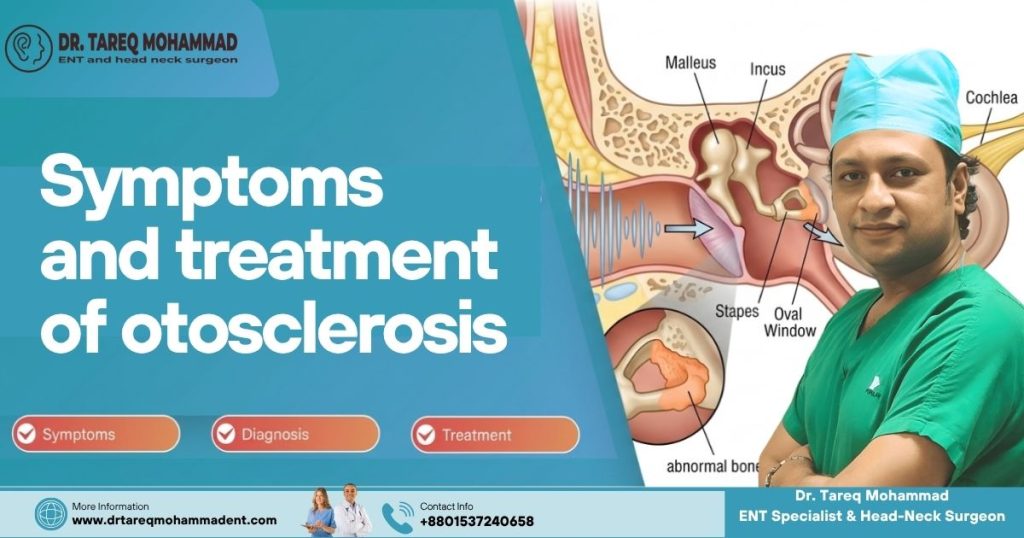
If your hearing has been slowly getting worse over the years, especially if a parent or sibling has a similar history, otosclerosis could be the reason. Understanding the symptoms and treatment of otosclerosis can help you recognize the condition early and explore appropriate treatment options.
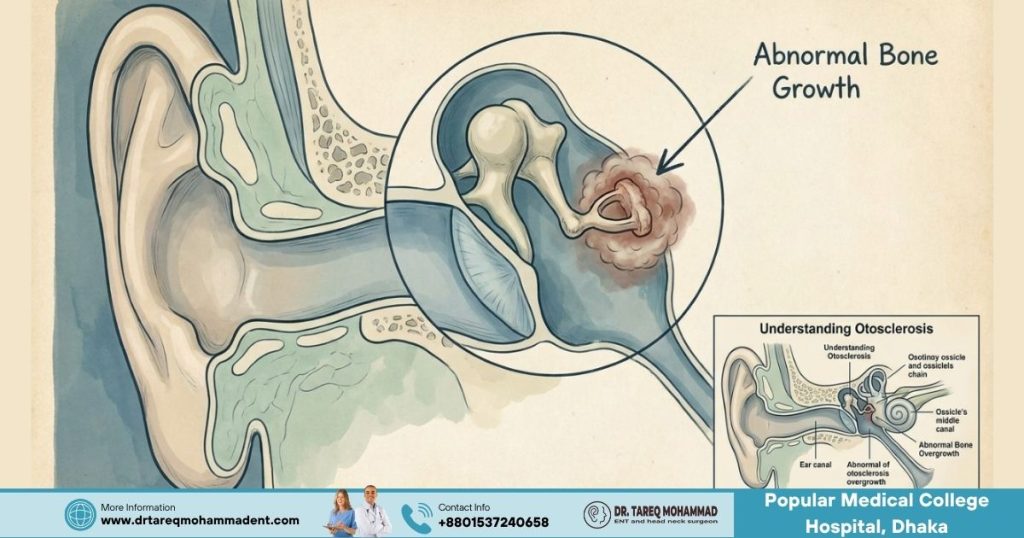
Otosclerosis is a condition where abnormal bone growth develops around a tiny bone in the middle ear called the stapes. The stapes is the smallest bone in the human body, and it plays a critical role in passing sound vibrations from the eardrum into the inner ear. When abnormal bone forms around it, the stapes gets fixed in place and can no longer vibrate freely. Sound simply doesn’t get transmitted the way it should, and hearing gradually declines.
This is different from hearing loss caused by nerve damage or aging. In my practice, I explain to patients that otosclerosis affects the “mechanical” part of hearing, not the nerve signal itself, which is exactly why it responds so well to surgical correction.
The exact cause isn’t fully understood, but several factors are known to play a role:
✦Genetics: Otosclerosis often runs in families. If a parent has it, there’s a meaningfully higher chance of developing it too.
✦Hormonal changes: Pregnancy can sometimes speed up progression, which is why some women first notice symptoms during or after pregnancy.
✦Autoimmune and viral factors: Some research points to a possible link with measles virus exposure or immune-related bone remodeling, though this isn’t confirmed in every case.
It’s not caused by loud noise exposure or ear infections, which is a common misunderstanding I hear from patients.
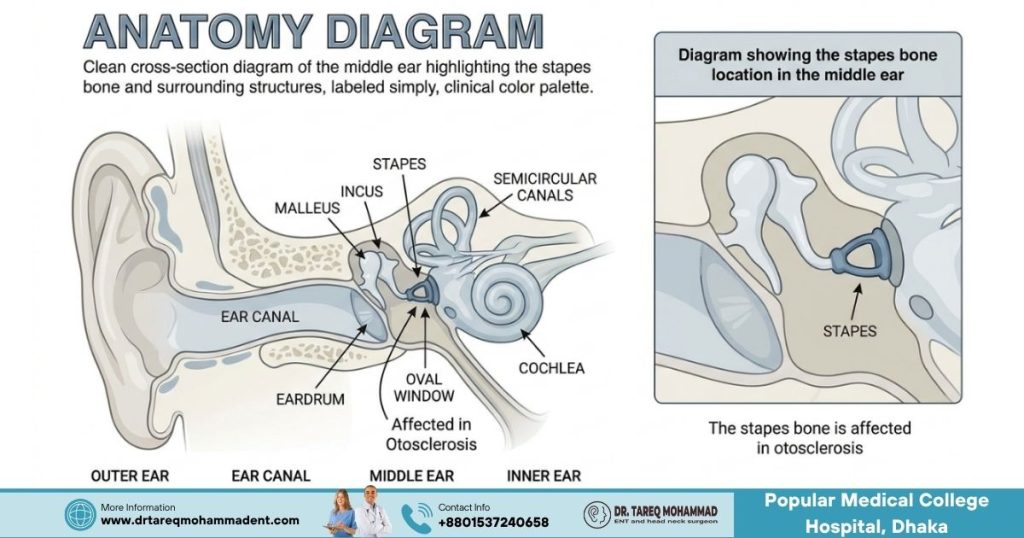
The symptoms usually develop slowly, over months to years, rather than appearing suddenly:
✦Gradual hearing loss, usually starting in one ear and eventually affecting both
✦Difficulty hearing low-pitched sounds or soft speech before other frequencies are affected
✦Tinnitus — a ringing, buzzing, or humming sound in the ear
✦Mild dizziness or balance issues in some cases, though this is less common
✦Hearing that seems better in noisy environments than in quiet rooms — this is a fairly specific clue for otosclerosis
When a patient tells me their hearing actually feels clearer at a noisy party than in a quiet office, that detail alone often points me toward otosclerosis.
Otosclerosis most commonly appears between the ages of 20 and 40, and it affects women more often than men. A family history of hearing loss, especially hearing loss that started at a young age, raises the likelihood significantly.
When a patient comes to me with these symptoms, diagnosis usually involves:
✦A detailed hearing history, including family history
✦Otoscopic examination to rule out other causes like infection or wax blockage
✦Pure tone audiometry, a hearing test that measures how well sound travels through air versus bone — this is often the most telling test for otosclerosis
✦Tympanometry, which checks how the eardrum and middle ear are functioning
CT scan of the temporal bone in select cases, to confirm the diagnosis and plan surgery precisely
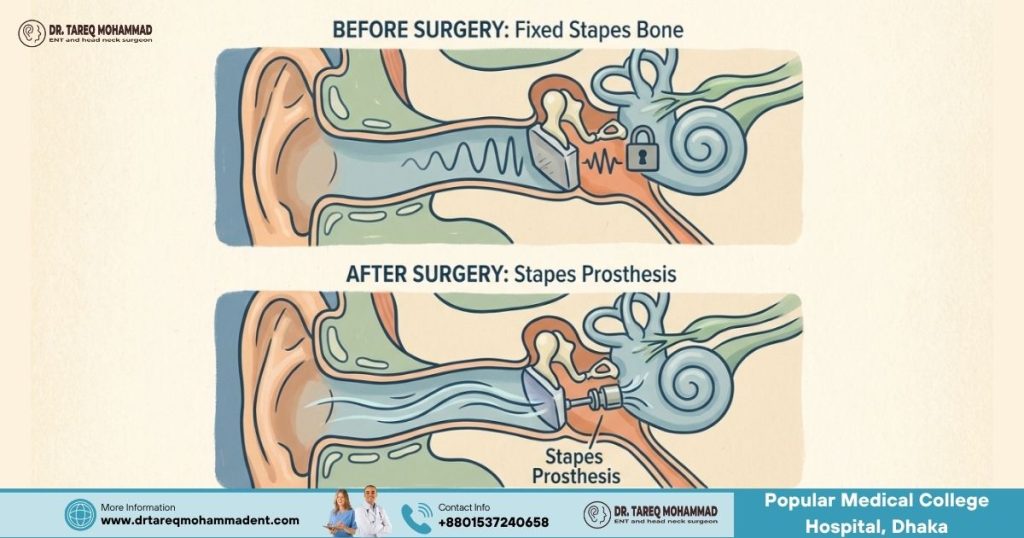
Not every patient needs surgery right away. For mild cases, or for patients who prefer to avoid surgery, a well-fitted hearing aid can restore useful hearing effectively. I always discuss this option honestly with patients — it doesn’t fix the underlying bone problem, but it manages the hearing loss well.
For most patients with confirmed otosclerosis and significant hearing loss, stapedotomy is the definitive treatment. In this procedure, I remove the fixed part of the stapes bone and replace it with a small prosthesis that restores normal sound transmission to the inner ear.
It’s typically done under local or general anesthesia, takes around 45 minutes to an hour, and in most cases is performed as day surgery or with a short hospital stay. Hearing improvement is often noticeable within a few weeks, once post-surgical swelling settles. If you’d like to understand what recovery and outcomes typically look like after this procedure, I’ve written about it in more detail in [Outcome of Endoscopic Stapedotomy Surgery for Conductive Deafness].
Left untreated, otosclerosis tends to progress gradually. Hearing loss usually continues to worsen over time, and untreated cases can eventually lead to more significant, harder-to-manage hearing impairment. It’s not dangerous to overall health, but the impact on daily communication, work, and quality of life tends to grow the longer it’s left unaddressed.
Most patients can resume light daily activities within a few days, though I usually advise avoiding heavy lifting, swimming, or air travel for a few weeks while the ear heals. Mild dizziness in the first few days after surgery is normal and settles on its own. For a fuller breakdown of recovery timelines across different ear surgeries, see [How Much Time Requires for Improvement After Different Types of Ear Surgery Like Tympanoplasty, Mastoidectomy and Stapedotomy?]
If you’ve noticed gradual hearing loss, especially with a family history of similar issues, it’s worth getting evaluated rather than waiting. Early diagnosis makes treatment simpler and outcomes better, whether that means a hearing aid or surgical correction.

Assistant Professor, Department of ENT & Head-Neck Surgery, ENT & Head-Neck Specialist
Chamber: Popular Medical College Hospital, Dhanmondi, Dhaka
Contact :+8801537240658
Website: https://drtareqmohammadent.com/
If you’ve noticed gradual hearing loss or a family history of similar issues, an ENT evaluation can clarify what’s happening and what your options are. You can book a consultation with Dr. Tareq Mohammad at Popular Medical College Hospital, Dhanmondi, Dhaka, through the contact details above.
Is otosclerosis hereditary?
Yes, it often runs in families. Having a parent or sibling with otosclerosis increases your own risk, though not everyone with a family history will develop it.
Can otosclerosis be treated without surgery?
Yes. Hearing aids can effectively manage the hearing loss for patients who prefer to avoid surgery or have milder symptoms. Surgery is recommended when hearing loss is more significant or progressive.
Is stapedotomy surgery risky?
Like any ear surgery, it carries small risks, including temporary dizziness, taste changes, or in rare cases further hearing loss. In experienced hands, the success rate for improving hearing is high.
Can otosclerosis affect both ears?
Yes, it commonly starts in one ear and progresses to affect the other ear over time in a large proportion of patients.
Can children get otosclerosis?
It’s uncommon in children. It most often develops in adults between 20 and 40 years of age.
Will my hearing loss come back after surgery?
For most patients, stapedotomy provides long-lasting hearing improvement. In a small number of cases, hearing loss can gradually return, and this can usually be managed with further evaluation.
How is otosclerosis different from age-related hearing loss?
Otosclerosis affects the mechanical movement of a bone in the middle ear and typically starts much earlier in life, while age-related hearing loss involves the inner ear nerve and develops later in life.
Does pregnancy make otosclerosis worse?
It can. Hormonal changes during pregnancy are known to sometimes accelerate the progression of otosclerosis in women who are predisposed to it.
Dr. Tareq Mohammad, MBBS, FCPS (ENT – Head & Neck Surgery), Assistant Professor at Popular Medical College Hospital, providing advanced ENT care with compassion and expertise.
© Copyright 2026 Dr. Tareq Mohammad - All Rights Reserved.
Need help? Team is just a message away