Blog Single
Tinnitus Treatment – Ringing in Ears Causes & Options


Ringing in the Ears (Tinnitus) Causes, Symptoms & Tinnitus Treatment
Quick Answer:
Tinnitus treatment depends on the cause. Doctors first look for fixable problems such as earwax, infection or hearing loss, then use hearing aids, sound therapy, counselling and lifestyle steps to make the ringing less bothersome. There is no single cure for every case, but most people learn to manage it well with proper guidance.
That faint hiss, buzz or ringing that nobody else can hear can make a quiet room feel loud and a night’s sleep feel impossible. This is tinnitus, and the right tinnitus treatment starts with finding out why it is happening. Tinnitus is a symptom, not a disease on its own, and in many people it can be reduced or made far less bothersome.
Dr. Tareq Mohammad is an ENT specialist in Dhaka who assesses ear, hearing and tinnitus problems at Popular Medical College Hospital, Dhanmondi, Dhaka. In this guide, you will learn what causes ringing in the ears, which signs need urgent attention, how doctors test for it, and which treatments and self-care steps can help.
What Is Tinnitus?
Tinnitus is the experience of hearing a sound, such as ringing, buzzing, hissing or humming, when there is no matching sound outside. It is very common, and it is a symptom of something else rather than a disease on its own.
For some people the sound is faint and comes and goes. For others it is constant and makes it hard to focus, relax or sleep. Tinnitus often goes together with hearing loss, but you can have tinnitus with normal hearing too.
The sound is real to the person who hears it. It is not “in your head” in the sense of being imagined, and it deserves a proper check rather than being brushed aside.
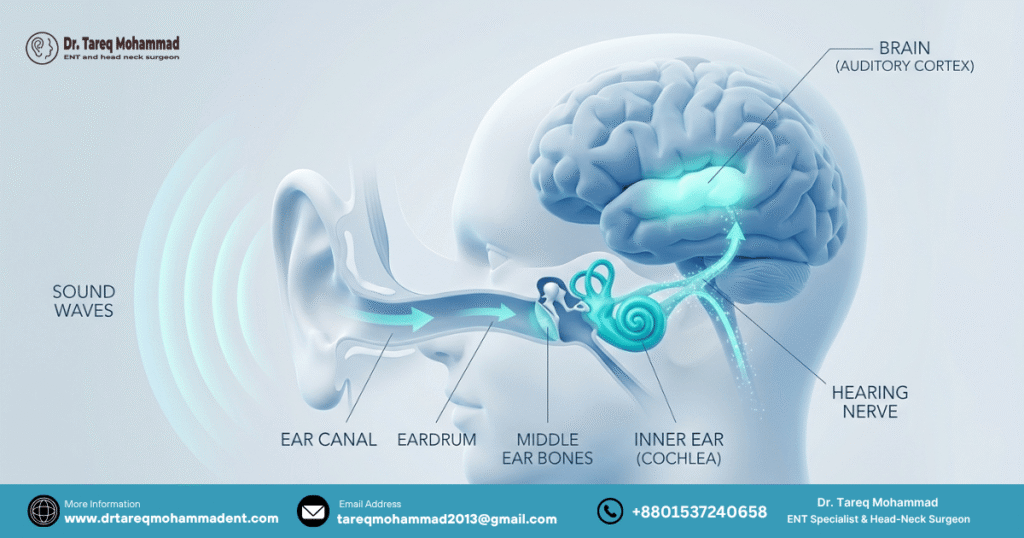
The main symptom is hearing a sound that has no outside source. The sound differs from person to person and can be in one ear, both ears or “inside the head”.
Common sounds people describe
✦Ringing or whistling
✦Buzzing or humming
✦Hissing or static
✦Clicking or crackling
✦A pulsing or whooshing sound that matches your heartbeat (pulsatile tinnitus)
Other things that often come with it
✦Hearing loss or muffled hearing
✦A feeling of fullness in the ear
✦Dizziness or balance problems
✦Difficulty sleeping or concentrating
✦Anxiety, irritability or low mood because of the constant sound
Common tinnitus | Pulsatile tinnitus | |
Sound | Ringing, buzzing, hissing | Rhythmic beat or whoosh in time with the pulse |
Possible links | Hearing loss, noise, earwax, ear conditions | Blood flow or blood vessel changes, middle ear conditions |
What to do | ENT and hearing assessment | Prompt ENT assessment, sometimes with imaging |
Many people notice the sound most at night, when the room is quiet. If it also comes with hearing changes, read about sudden hearing loss and why speed matters.
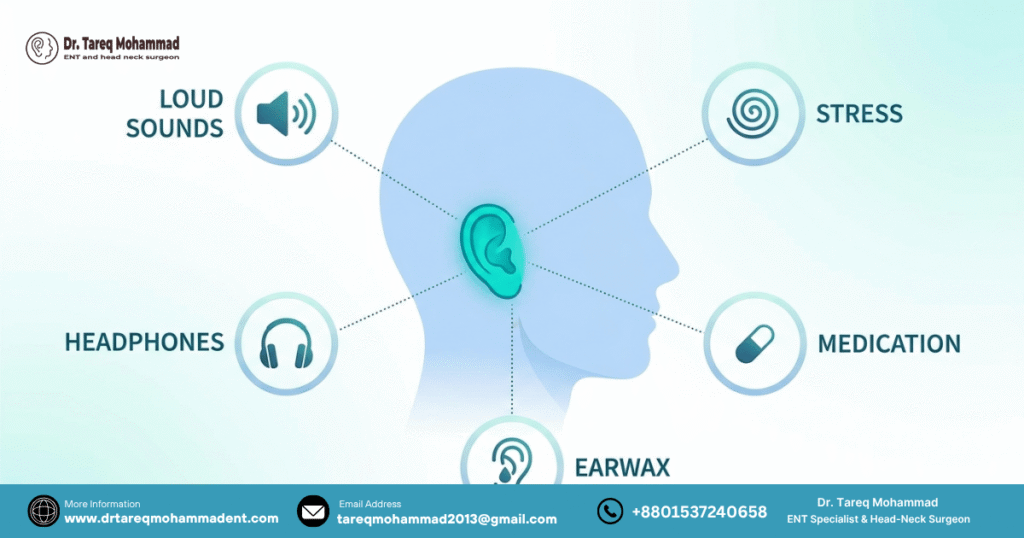
Ringing in the ears has many causes, from simple blockages to long-term hearing changes. In many people, the cause is linked to damage or changes in the inner ear’s tiny sound-sensing cells.
Possible cause | Typical clues |
Earwax or blocked ear canal | Muffled hearing, ear fullness, often one ear |
Ear infection or fluid behind the eardrum | Ear pain, discharge, blocked feeling after a cold |
Loud noise exposure | Ringing after loud music, machines, fireworks or crowds |
Age-related hearing loss | Slowly reducing hearing with high-pitched ringing in both ears |
Otosclerosis | Gradual hearing loss, often with tinnitus; see our guide on otosclerosis symptoms and treatment |
Meniere’s disease | Ringing, ear fullness and spinning dizziness that comes in attacks |
Certain medicines | Ringing that began after starting or changing a medicine |
Jaw, neck or blood pressure problems | Ringing linked to jaw clicking, neck strain or raised blood pressure |
Stress, poor sleep and tiredness | Tinnitus feels louder during stressful or sleepless periods |
Never stop a prescribed medicine on your own because of tinnitus. Tell your doctor, who can review the medicine safely. A tumor on the hearing nerve is a rare cause, usually affecting one ear, which is one reason one-sided tinnitus is always checked.
How Is Tinnitus Diagnosed Before Tinnitus Treatment?
An ENT specialist diagnoses tinnitus by listening to your story, examining your ears and testing your hearing. Finding the cause is the first step of good tinnitus treatment.
The doctor will ask about the sound, which ear, how long it has lasted, noise exposure, medicines, dizziness and sleep. Then these steps may follow:
✦Ear examination: with an otoscope or ear endoscope to check for wax, infection and the eardrum
✦Hearing test (audiometry): measures hearing in each ear and shows any hearing loss
✦Middle ear test (tympanometry): checks how well the eardrum and middle ear are working
✦Balance assessment: if dizziness is present
✦Blood tests: selected cases, such as thyroid, blood sugar or other checks
✦MRI or CT scan: advised for ringing in only one ear, uneven hearing loss, a pulsing sound or other warning signs
Bring any earlier hearing tests, scans and medicine lists to your visit with any ENT doctor in Dhaka. They help avoid repeated tests and give the doctor a fuller picture.

The best tinnitus treatment depends on the cause. If a treatable problem is found, treating it may reduce or stop the sound. If not, treatment focuses on making the tinnitus less noticeable and less upsetting.
- Treat the underlying cause
- Safe removal of earwax
- Medicines for ear infection or inflammation
- Treating fluid behind the eardrum
- Reviewing a medicine that may be involved
- Managing blood pressure, jaw or neck problems when they are linked
- Hearing support
- Hearing aids when hearing loss is present; they bring back outside sounds, which often makes tinnitus less noticeable
- Sound therapy
- Soft background sound, such as a fan, nature sounds or a sound-masking device, helps distract the brain from the ringing, especially at night
- Counselling and relaxation support
- Counselling-based approaches and relaxation methods help people react less strongly to the sound, and may improve sleep and mood
- Medicines for related problems
- No tablet cures tinnitus. A doctor may sometimes treat associated anxiety, poor sleep or dizziness. Do not take supplements or “tinnitus cures” without medical advice.
- Surgery for specific ear conditions
- Tinnitus linked to a surgical ear problem, such as a perforated eardrum or otosclerosis, may improve after treating that condition, though improvement cannot be promised
Approach | Best for | Key point |
Cause-based treatment | Wax, infection, fluid, medicine effect | Often the most direct way to reduce the sound |
Hearing aids | Tinnitus with hearing loss | Makes outside sound clearer, reduces focus on ringing |
Sound therapy | Night-time or quiet-room tinnitus | Distracts the brain; no medicine needed |
Counselling and relaxation | Tinnitus that causes distress or poor sleep | Helps you cope and react less to the sound |
Ear surgery | Specific conditions such as otosclerosis | Treats the cause; results vary |
At Popular Medical College Hospital in Dhanmondi, Dr. Tareq Mohammad examines each patient’s ears carefully, reviews hearing tests, explains the likely cause in simple language, and plans tinnitus treatment around the individual. Endoscopic ear surgery is part of his expertise when an ear condition needs a surgical solution. Results differ from person to person and cannot be guaranteed. See our full list of ENT services.
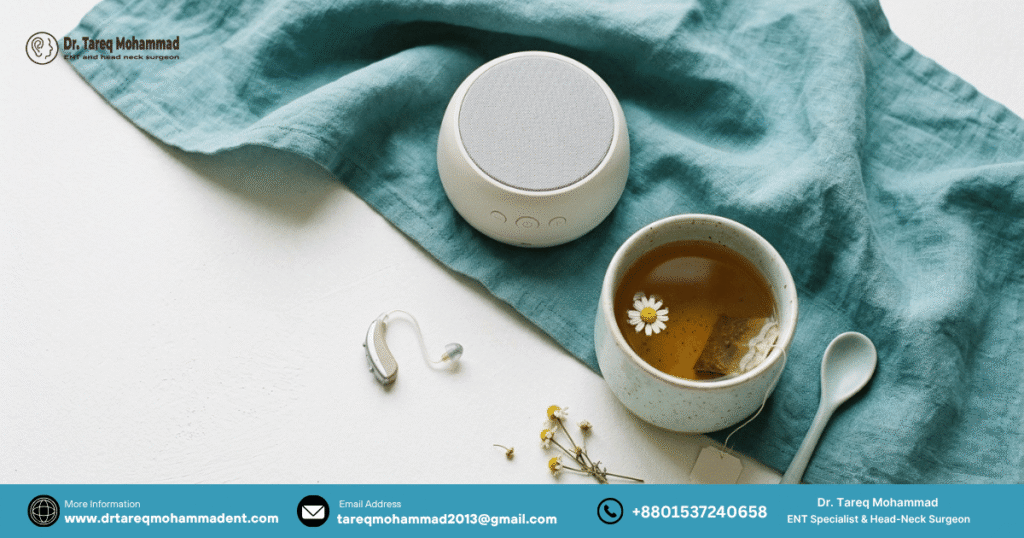
Home steps cannot cure tinnitus, but they can make it easier to live with and support your doctor’s plan. Simple steps include:
✦Use soft background sound at night, such as a fan or gentle nature sounds
✦Protect your ears from loud noise with earplugs or earmuffs
✦Keep headphone volume low and take listening breaks
✦Practise relaxation, slow breathing or gentle exercise to reduce stress
✦Keep a regular sleep routine and avoid screens late at night
✦Notice whether caffeine, alcohol or smoking makes it worse for you, and cut back if so
✦Keep a short diary of when the sound is louder; it helps the doctor
What to avoid
✦Pushing cotton buds, pins or sharp objects into the ear
✦Using ear drops, home remedies or supplements without advice
✦Sitting in complete silence, which can make the sound feel louder
✦Ignoring one-sided tinnitus or sudden changes in hearing
See an ENT doctor in Dhaka if ringing lasts more than a week or two, keeps returning, disturbs your sleep, or comes with any hearing change. Get checked promptly if you notice any of these red flags:
✦Ringing in only one ear
✦A pulsing sound that beats with your heartbeat
✦Sudden or fast-worsening hearing loss
✦Dizziness, spinning or balance problems
✦Ear discharge, pain or a blocked ear that does not clear
✦Facial weakness or numbness
✦Tinnitus after a head or ear injury
✦Feeling very low, anxious or unable to cope because of the sound
Seek emergency care straight away for sudden hearing loss together with severe dizziness, facial weakness, a severe headache or confusion. Finding the best ENT doctor in Dhaka for tinnitus starts with a proper ear examination and hearing test, not guesswork.
Why Choose Dr. Tareq Mohammad?
People searching for the best ENT doctor in Dhaka for ringing in the ears usually want careful testing, honest explanations and a clear plan. Dr. Tareq Mohammad holds MBBS, FCPS (ENT – Head & Neck Surgery) and FICS (USA). He is Assistant Professor in the Department of ENT at Popular Medical College Hospital, Dhanmondi, and has worked in otolaryngology since 2012.
As an ENT specialist in Dhaka whose work includes hearing loss, tinnitus and endoscopic ear surgery such as tympanoplasty and stapedotomy, he looks at the whole picture: your ears, your hearing test and your daily life. Questions are welcomed, findings are explained simply, and treatment is matched to the individual. Learn more on our page about the best ENT doctor in Dhaka.
- What is the best tinnitus treatment?
The best tinnitus treatment depends on what is causing the ringing. If the cause is earwax, infection or a treatable ear condition, treating it can reduce or stop the sound. When no single cause is found, hearing aids, sound therapy, counselling and good sleep habits help many people feel much less bothered. An ENT examination guides the plan. - Can tinnitus go away on its own?
Sometimes. Tinnitus after loud noise, an ear infection or earwax often settles once the cause is treated or the ear recovers. Tinnitus that lasts more than a few weeks, or comes with hearing loss, should be checked by an ENT doctor in Dhaka rather than left alone, because early assessment gives more options. - Is tinnitus a sign of a serious problem?
Most tinnitus is not dangerous, but it can sometimes point to a problem that needs treatment. Warning signs include ringing in only one ear, a pulsing sound that beats with your heartbeat, sudden hearing loss, dizziness or facial weakness. These need prompt medical evaluation rather than waiting. - Can earwax or an ear infection cause ringing in the ears?
Yes. A blocked ear canal from wax, a middle ear infection or fluid behind the eardrum can all cause ringing or a blocked, muffled feeling. These causes are often treatable. Do not push cotton buds or sharp objects into the ear; let an ENT doctor examine and clean it safely. - Why is tinnitus worse at night?
Tinnitus often seems louder at night because the room is quiet and there is little else to distract your brain from the sound. Stress and tiredness can also make it feel stronger. Soft background sound, a calming bedtime routine and treating any underlying cause can help you sleep more comfortably. - Is there a permanent cure for tinnitus?
There is no single cure that works for every person. When a clear cause is found and treated, tinnitus may fade or stop. When it continues, the goal is to make it less noticeable and less distressing, using hearing aids, sound therapy, counselling and healthy habits. Many people adapt well over time. - Who is the best ENT doctor in Dhaka for tinnitus?
Look for an experienced ENT specialist in Dhaka who examines the ears carefully, arranges proper hearing tests and explains the options clearly. Dr. Tareq Mohammad, MBBS, FCPS (ENT – Head & Neck Surgery) and Assistant Professor at Popular Medical College Hospital, Dhanmondi, treats hearing loss and tinnitus and is a trusted choice for patients seeking an ENT doctor in Dhaka.

Conclusion and Appointment
Ringing in the ears can be tiring, but you do not have to simply put up with it. Understanding the cause is the first step, and the right tinnitus treatment can reduce the sound or make it far less bothersome. Early assessment matters, especially if the ringing is in one ear, pulses, or comes with hearing loss or dizziness.
If tinnitus is affecting your sleep, focus or peace of mind, book a visit with Dr. Tareq Mohammad, an experienced ENT specialist in Dhaka.
✦Phone: +8801537240658
✦WhatsApp: Message on WhatsApp
✦Chamber: Popular Medical College Hospital, House 25, Road 2, Dhanmondi, Dhaka 1205
✦Visiting hours: Saturday 3 PM–8 PM; Sunday–Thursday 5 PM–9 PM
✦Book online: Book an appointment