
Child Snoring Adenoids – Causes, Signs & Treatment
Blog Single


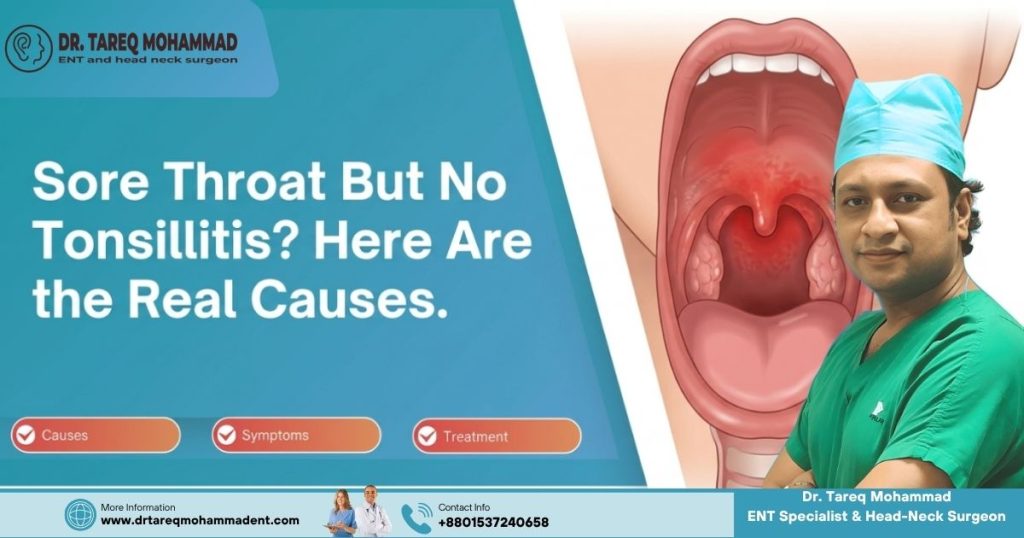
In my practice, I see a lot of patients who come in convinced their Causes of sore throat other than tonsillitis. When I examine them, though, the tonsils often look completely normal. That surprises most people — they assume any throat pain automatically points to the tonsils. It doesn’t.
The throat is a shared pathway for breathing, swallowing, and speaking, and several different structures along that pathway can become irritated or inflamed. Tonsillitis is just one possible cause among many.
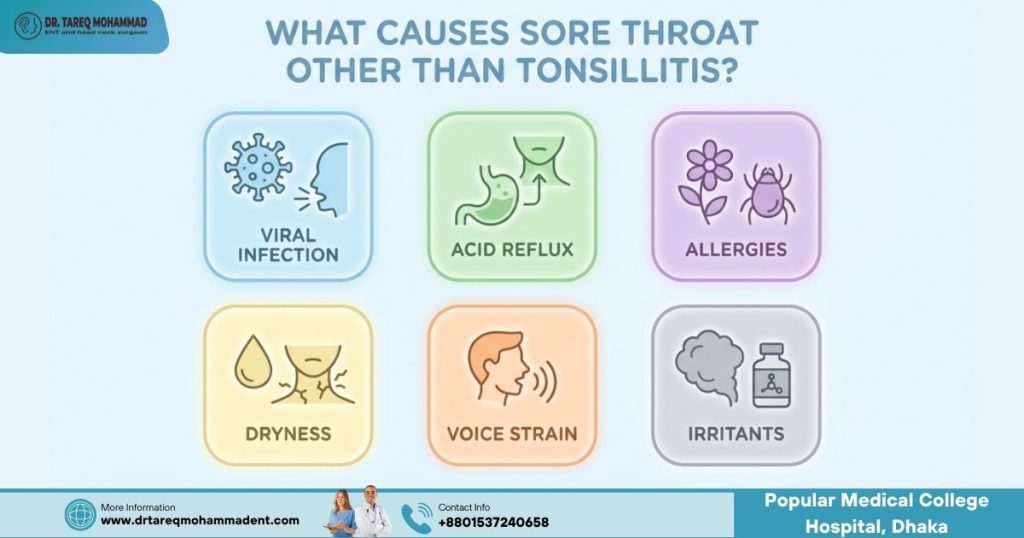
A sore throat that isn’t tonsillitis is usually caused by viral pharyngitis, acid reflux, allergies, post-nasal drip, dry air, voice strain, or irritants like smoke and pollution. These conditions inflame the throat lining without involving the tonsils at all.
Below, I’ll walk through each of these in more detail, the way I would with a patient sitting across from me.
This is by far the most common reason I see patients with a sore throat and clear tonsils. A viral infection — the same kind that causes a cold or flu — inflames the lining of the throat (the pharynx) without necessarily involving the tonsils. It usually comes with a runny nose, mild fever, body aches, and gradually improves on its own within a week.
I often ask patients about their eating habits and sleep position when their throat pain is worse in the morning or after meals. Stomach acid can travel up into the throat, especially at night, and irritate the throat lining. This is called laryngopharyngeal reflux. Patients usually describe a burning or scratchy feeling rather than sharp pain, sometimes with a hoarse voice or a sensation of a lump in the throat.
When the nose or sinuses produce excess mucus — from sinusitis, allergies, or a nasal infection — that mucus drips down the back of the throat continuously. Over time, this constant drainage irritates the throat lining and causes a persistent scratchy or sore feeling, especially noticeable in the morning.
Seasonal allergies, dust, or environmental triggers can inflame the throat lining directly, or indirectly through post-nasal drip. This type of sore throat often comes with sneezing, itchy eyes, and a runny nose, and tends to follow a seasonal pattern.
I see this often in patients who sleep with the mouth open, use air conditioning heavily, or don’t drink enough fluids. A dry throat lining becomes irritated much more easily, and the pain is usually mild, worse in the morning, and improves once the person hydrates.
Teachers, singers, call-center workers, and anyone who talks loudly or for long periods can strain the throat and voice box. This leads to laryngitis — inflammation of the larynx — causing hoarseness and throat discomfort rather than classic tonsil pain.
Smoke, vehicle pollution, strong fumes, and even chlorine from swimming pools can irritate the throat lining directly. Patients exposed to these regularly often have a chronic mild sore throat that doesn’t fully go away until the irritant is reduced.
In a smaller number of cases, a persistent sore throat that isn’t improving can be related to thyroid swelling, a foreign body sensation from muscle tension, or — rarely — a growth in the throat or voice box. This is why a sore throat that lasts more than two to three weeks always needs a proper ENT evaluation.
When a patient comes to me with throat pain and normal-looking tonsils, I take a detailed history first — timing, triggers, associated symptoms, diet, and lifestyle. Then I examine the throat, nose, and sometimes the voice box with a small camera (laryngoscopy) if the symptoms are persistent or the voice is affected. This helps me pinpoint whether the cause is reflux, allergy, infection, or something that needs further investigation.
I usually tell my patients not to worry about a mild sore throat that clears up within a week. But you should get it checked if:
✦The sore throat lasts longer than 2–3 weeks
✦You have persistent hoarseness
✦You feel something is “stuck” in your throat
✦You notice a neck swelling along with the sore throat
✦You have difficulty swallowing or breathing
✦The pain keeps coming back despite home care
Most non-tonsillitis sore throats can be reduced by staying hydrated, treating reflux and allergies properly, avoiding smoke and pollution, resting the voice when needed, and managing chronic sinus issues. When the underlying cause is addressed, the throat symptoms usually settle down too.
The important point I always tell my patients is this:Causes of sore throat other than tonsillitis is a symptom, not a diagnosis. Finding the actual cause is what makes the treatment work.

Assistant Professor, Department of ENT & Head-Neck Surgery, ENT & Head-Neck Specialist
Chamber: [Popular Medical College Hospital, Dhanmondi, Dhaka]
Contact: +8801537240658
Website: https://drtareqmohammadent.com/
If your Causes of sore throat other than tonsillitis isn’t going away, keeps coming back, or comes with hoarseness, difficulty swallowing, or neck swelling, it’s worth getting a proper ENT evaluation rather than guessing at the cause.
Dr. Tareq Mohammad
sees patients at Popular Medical College Hospital, Dhanmondi, Dhaka
— visit drtareqmohammadent.com to book an appointment.
1. If my tonsils look normal, why does my throat still hurt?
Throat pain can come from the pharynx, larynx, nasal drainage, or acid reflux — none of which involve the tonsils directly. Normal-looking tonsils simply mean tonsillitis isn’t the cause.
2. Can acid reflux really cause a sore throat without heartburn?
Yes. Many patients with laryngopharyngeal reflux never experience typical heartburn — they only notice throat irritation, hoarseness, or a lump-in-throat sensation.
3. How long does a viral sore throat usually last?
Most viral sore throats improve within 5–7 days with rest, fluids, and supportive care.
4. Is a sore throat from allergies dangerous?
No, allergic throat irritation is not dangerous, but it can become chronic and uncomfortable if the underlying allergy isn’t managed.
5. When does a sore throat mean I need antibiotics?
Antibiotics are only needed for bacterial infections, which an ENT specialist or doctor confirms through examination — not every sore throat requires them.
6. Can a persistent sore throat be something serious?
In most cases, no. But a sore throat lasting more than 2–3 weeks, especially with hoarseness or neck swelling, should be examined to rule out more serious causes.
7. Does smoking make a sore throat worse?
Yes. Smoking directly irritates the throat lining and can prolong or worsen an existing sore throat.
8.What are the common causes of sore throat other than tonsillitis?
Common causes of sore throat other than tonsillitis include viral infections, allergies, postnasal drip, acid reflux, dry air, dehydration, smoking, and throat irritation. Persistent or recurrent sore throat may need an ENT evaluation to identify the underlying cause and guide appropriate treatment.

Dr. Tareq Mohammad, MBBS, FCPS (ENT – Head & Neck Surgery), Assistant Professor at Popular Medical College Hospital, providing advanced ENT care with compassion and expertise.
© Copyright 2026 Dr. Tareq Mohammad - All Rights Reserved.
Need help? Team is just a message away